Every bulk cargo port in the world has the same problem: nobody can agree on how much cargo was actually discharged. The difference between what was loaded and what was received has fueled billions of dollars in disputes globally. One Gulf Coast port decided to fix it, and in doing so became the first terminal in the world to deploy computer vision for automated cargo settlement.
The Problem Nobody Had Solved
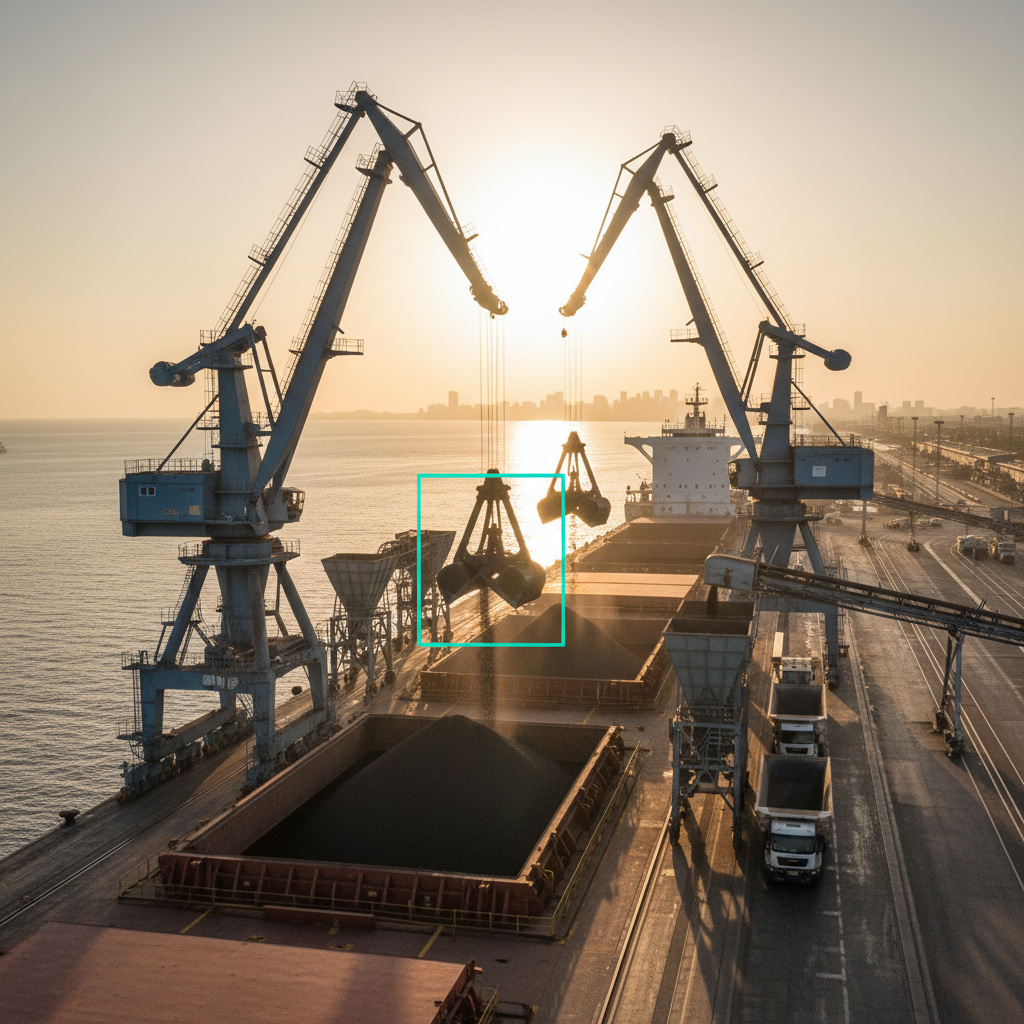
Port Tampa Bay handles millions of tons of bulk cargo annually: phosphate, aggregates, steel, petroleum products. Like every other bulk port, it relied on tally clerks standing near cranes, visually estimating how full each grab bucket was, hundreds of times per vessel. Draft surveys provided a gross tonnage figure, but with accuracy of plus or minus five tons per grab cycle. Over a full vessel discharge, those errors compounded into discrepancies that triggered commercial disputes worth $50,000 to $100,000 per vessel.
This was not a Port Tampa Bay problem. It was an industry-wide problem. Globally, the maritime cargo sector loses billions annually to counting inaccuracies and the disputes they create. The difference between shipper and receiver figures is not a rounding error; it is a commercial conflict baked into every transaction. For decades, ports accepted this as the cost of doing business.
A Camera-Based Approach That Changed the Game
What made Port Tampa Bay's approach different was a deceptively simple insight: the cameras were already there. Every port has CCTV cameras on cranes, berths, and yards, generating thousands of hours of footage used for security review and little else. The Sensfix SAAI Suite turned these passive recording devices into active measurement instruments.
The system tracks each crane grab bucket through six distinct states (open, closing, closed and loaded, hoisting, traversing, discharging) using computer vision. At each state transition, AI models analyze the bucket's fill level, material profile, and dimensional characteristics to estimate weight. A novel AI cable-tracing technique tracks crane hoist cable geometry from the CCTV feed, providing bucket position and load data without any physical sensors on the crane itself.
No new hardware. No crane downtime for installation. No additional equipment to maintain in a corrosive marine environment. The AI layer is purely additive: new intelligence from existing infrastructure.
The Results That Made the Industry Take Notice
The production results were unambiguous:
- Sub-1% error rate on cumulative vessel totals, an order-of-magnitude improvement over manual methods
- 100% automated counting with no tally clerks required, operating continuously without fatigue or shift changes
- 95% accuracy improvement compared to previous manual counting methods
- Cargo disputes effectively eliminated, recovering $2 to $3 million in annual losses from inaccuracies and dispute resolution
These results were achieved in weeks, not months, a direct consequence of deploying on existing camera infrastructure rather than undertaking a hardware modernization project.
| Metric | Before (Manual) | After (AI-Powered) |
|---|---|---|
| Counting Method | Manual tally clerks | 100% automated CV |
| Accuracy | ±5 tons per grab cycle | <1% cumulative error |
| Cargo Disputes | $50K–$100K per vessel | Effectively eliminated |
| Annual Losses | $2M–$3M | Substantially recovered |
| Hardware Required | Tally clerks + draft surveys | Existing CCTV cameras only |
Why This Matters Beyond Tampa Bay
Port Tampa Bay's deployment is significant not just for its results, but for what it proves about the broader smart port opportunity. The smart port market is projected to reach $6.1 billion by 2033, yet before this deployment, no port anywhere in the world had successfully used computer vision for cargo settlement in production. The gap between AI hype and operational reality in maritime has been enormous.
This deployment closes that gap. It demonstrates that AI-powered cargo counting is not a laboratory concept or a conference demo. It is a production system running on commodity cameras, delivering measurable financial returns, at a real port handling real cargo. And cargo counting is just the starting point: crane safety monitoring, berth utilization, container damage detection, and environmental compliance all represent proven applications deployable on the same platform and the same camera infrastructure.
The First CV-Based Cargo Settlement System in Production
Port Tampa Bay did not just solve its own counting problem. It created a template for every bulk cargo port in the world: start with existing CCTV infrastructure, deploy AI that delivers measurable ROI immediately, and expand into additional applications as operational priorities evolve. The technology is proven, the economics are compelling, and the results are documented. For the full technical details, deployment architecture, and detailed outcome analysis, read the complete case study.
Ready to See These Results?
Book a personalized demo and see how the SAAI Suite delivers measurable outcomes for your operations.