
Sensfix Applied AI Blueprint
Applied AI Blueprint: Hospital Management
How Proven Multimodal AI Capabilities Address 16 Hospital Facility & Clinical Operations Domains
The $50 Billion Patient Safety Crisis — and the AI Opportunity
Patient falls alone cost U.S. hospitals $50 billion annually, with a typical 200-bed hospital experiencing 300–600 falls per year at $14,000–$50,000 each in additional care costs. Healthcare-associated infections affect 1 in 31 hospitalized patients daily (CDC), adding $28–$45 billion in annual costs. 80–99% of ICU alarms are false or clinically insignificant, leading to alarm fatigue that causes clinicians to miss critical events. The average time to classify and dispatch a maintenance issue is 21 minutes (JLL benchmark). These are not abstract statistics. They represent preventable harm, wasted resources, and operational friction that AI can directly address.
Leading health systems are already deploying AI at scale: Artisight across 400+ hospitals with 17,000+ live patient rooms, AvaSure virtual monitoring in 1,200+ hospitals, and Evolv weapon detection screening 900,000+ visitors daily at 500+ hospital buildings. But most of these are single-purpose point solutions, each requiring separate procurement, integration, and management. The result is a fragmented technology stack that creates as many integration problems as it solves.
Sensfix is already deployed across 46 enterprise clients on 3 continents: monitoring infrastructure at a major US port, managing maintenance at the world's second-largest train manufacturer, and digitizing operations for a European retail chain with 4,600+ stores. The SAAI platform is the only system unifying computer vision, audio AI, IoT, and workflow automation in a single suite. 42+ proprietary AI models have been trained across industrial facilities globally. This Blueprint documents how every one of those proven capabilities maps to a specific hospital operations domain.
$50B
Annual cost of patient falls in U.S. hospitals
$28–$45B
Annual cost of healthcare-associated infections
21 min
Avg. maintenance issue classification (JLL)
73%
Healthcare workers affected by workplace violence
$26B+
Annual cost of pressure injuries
80–99%
ICU alarms that are false or clinically insignificant
Patient Fall Detection & Virtual Monitoring
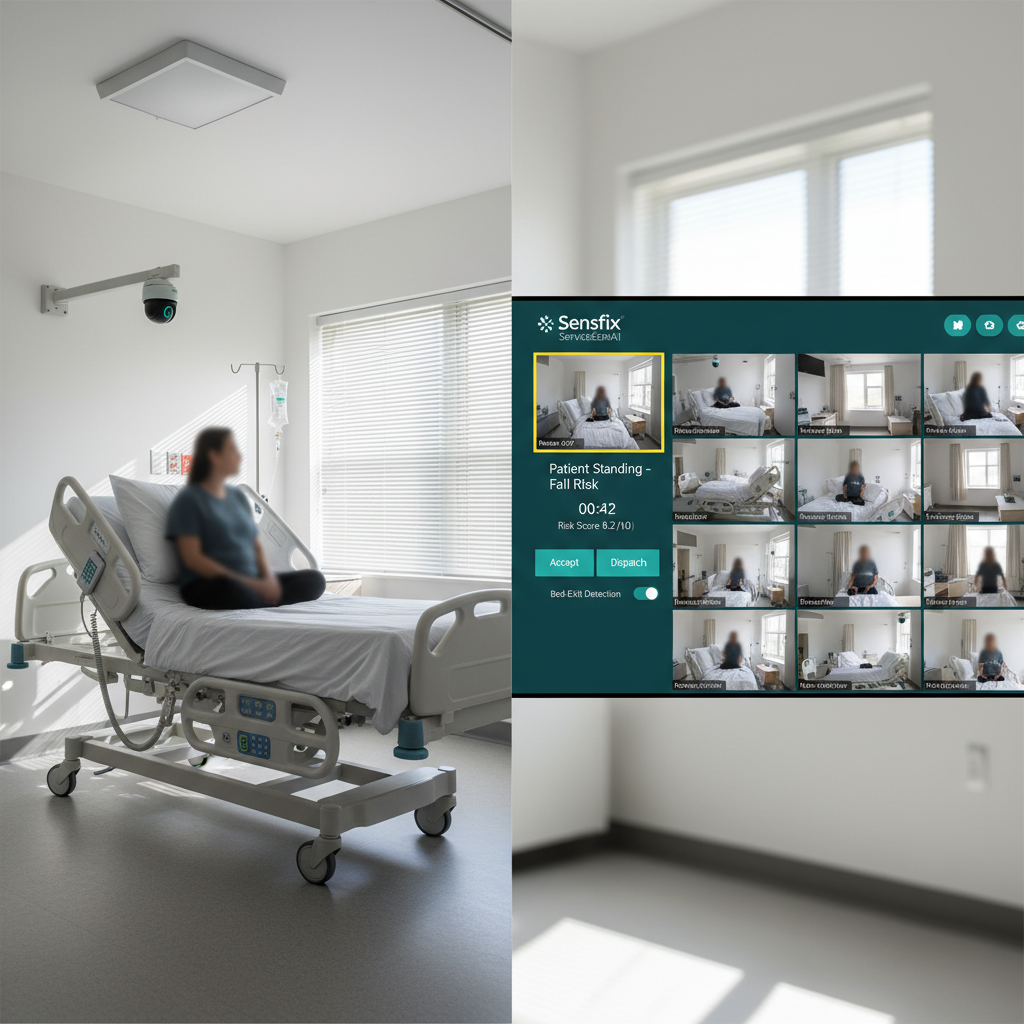
The Problem
Patient falls are the most commonly reported safety event in U.S. hospitals, costing $50 billion annually. A typical 200-bed hospital experiences 300–600 falls per year, each costing $14,000–$50,000 in additional care. Physical 1:1 sitters cost $200–$500 per patient per day, and bed alarms have notoriously high false-alarm rates.
Named Hospital Deployments with Results
| Deployment | Scope | Result |
|---|---|---|
| Artisight at Guthrie Clinic (NY/PA) | 400+ hospitals, 17,000+ live patient rooms | 40% year-over-year reduction in falls with injury; $6,480/day savings per 16 high-risk patients; $7M saved in traveling nurse expenses |
| AvaSure TeleSitter | 1,200+ hospitals | 50%+ reduction in adverse events; 75%+ reduction in 1:1 sitter needs |
| Northwestern Medicine | Smart hospital deployment | Falls dropped 32% with 23% improvement in nurse call response time |
| Kepler Vision Night Nurse at UZ Brussel | NICU & patient rooms | 100% fall detection reliability; 99% reduction in false alarms vs. motion sensors |
| Hospital Seberang Jaya (Malaysia) | Acute Stroke Unit | 83.33% reduction in patient falls |
How Sensfix Deploys on Infrastructure Hospitals Already Have
ServiceScanAI deploys on existing hospital CCTV cameras — the same computer vision platform proven at a European retail chain for real-time floor hazard and obstruction detection. Multimodal Rule Engine triggers automated alerts (‘If patient bed-exit detected THEN alert nursing station’).
TaskflowDigitizerAI documents safety rounds with photo evidence. Unlike dedicated fall-detection vendors requiring $30K–$100K per unit, Sensfix uses infrastructure every hospital already has — zero new hardware.
Hand Hygiene & Infection Control Monitoring
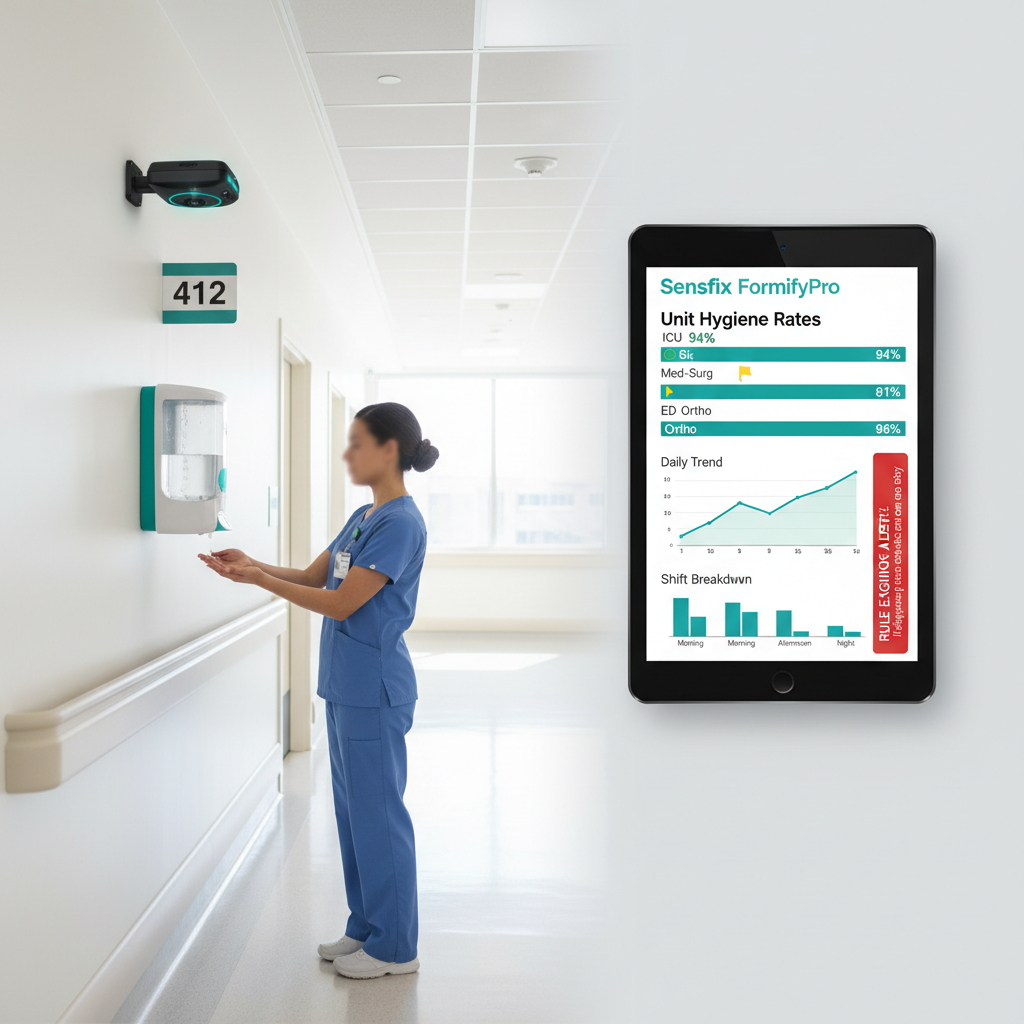
The Problem
Healthcare-associated infections (HAIs) affect 1 in 31 hospitalized patients daily (CDC), costing U.S. hospitals $28–$45 billion annually. Manual hand hygiene audits observe only a fraction of compliance events and suffer from well-documented observer bias, leaving the vast majority of non-compliance undetected.
Published Clinical Deployments
| Deployment | Scope | Result |
|---|---|---|
| Stanford/Intermountain Healthcare | Ceiling-mounted depth sensors, privacy-safe 3D silhouettes | Higher specificity and lower false-negative rates than human observation (published in JAMIA) |
| CareAI | 1,800+ care facilities | Continuous ambient hand hygiene monitoring at scale |
| Artisight at Northwestern Medicine | Computer vision across patient rooms | 23% improvement in nurse call response time; 32% fall reduction as part of broader smart hospital deployment |
One Platform for Hygiene, Cleanliness, and Equipment
ServiceScanAI monitors hand hygiene compliance via existing CCTV — the same platform that tracks cleanliness compliance at Sensfix’s European retail chain. Multimodal Rule Engine enforces ‘If dispenser use not detected after room entry THEN alert’ logic.
FormifyPro provides digital infection control audit templates for JCI/CMS readiness. One platform monitors hand hygiene AND floor cleanliness AND equipment status — not three separate vendors.
Hospital Facility Cleanliness & Safety Monitoring
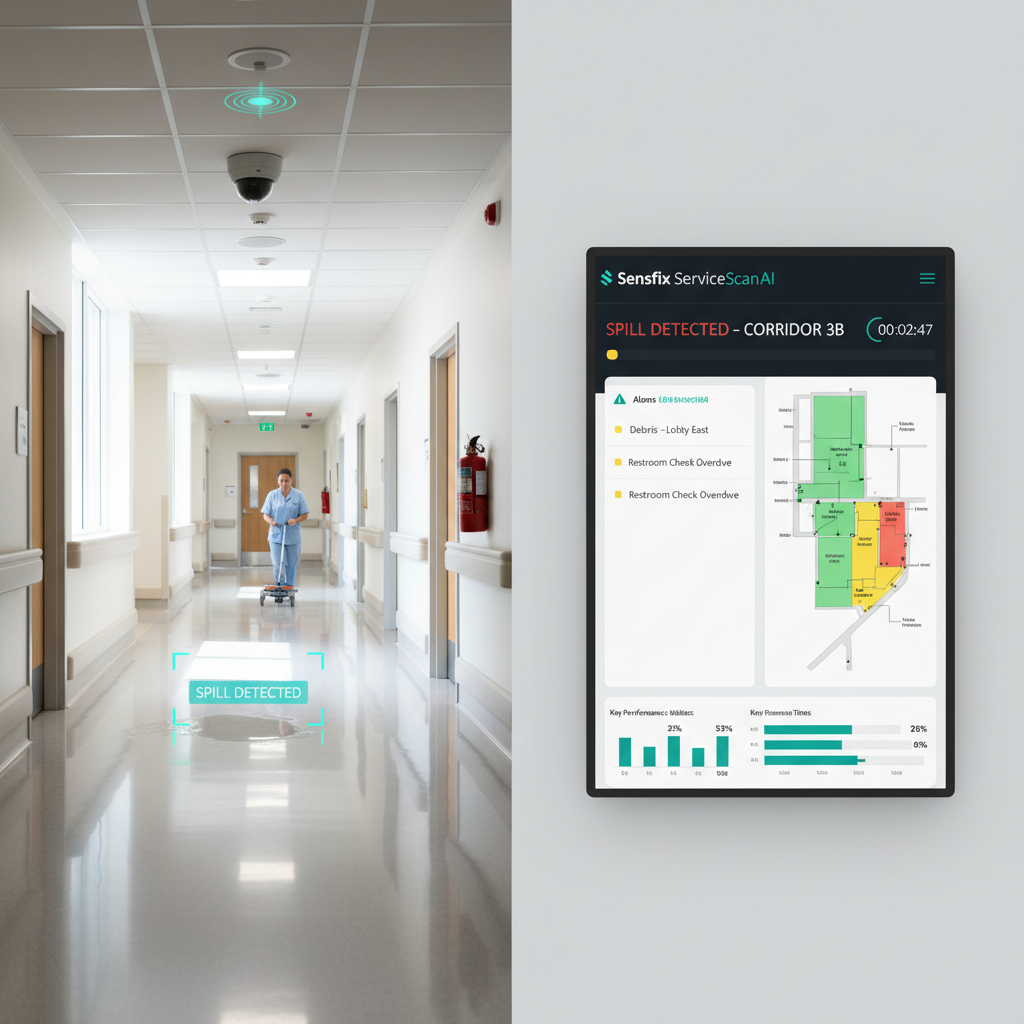
The Problem
Slip-and-fall incidents cost healthcare over $11 billion per year, with an average injury cost of $20,000 and $50,000 per legal claim. Hospital cleanliness is a top CMS patient experience metric and directly impacts HCAHPS scores, yet manual walk-through inspections can only sample a fraction of the facility at any given time.
Proven Deployments Across Industries
| Deployment | Scope | Result |
|---|---|---|
| Sensfix at European retail chain | Existing cameras + crew mobile phones | Floor cleanliness and pathway obstructions monitored as daily compliance metric across all stores |
| Badger Technologies | 1,000+ retail stores | 95%+ detection accuracy for spills, debris, and hazards |
| Visionify (cross-industry) | AI-powered spill/hazard detection on existing cameras | 45% reduction in incident response times; 30% decrease in insurance premiums |
The Identical Technology, Applied to Healthcare
ServiceScanAI deploys 42+ proprietary defect models on existing hospital CCTV for spill, dirt, and obstruction detection — the identical technology proven at Sensfix’s European retail chain for continuous floor monitoring. Multimodal Rule Engine triggers ‘If spill in hallway > 3 min THEN alert nearest EVS staff’ logic.
TaskflowDigitizerAI provides incident documentation with photo evidence. No robots, no new hardware — just existing cameras and smartphones.
Environment of Care Inspection Digitization
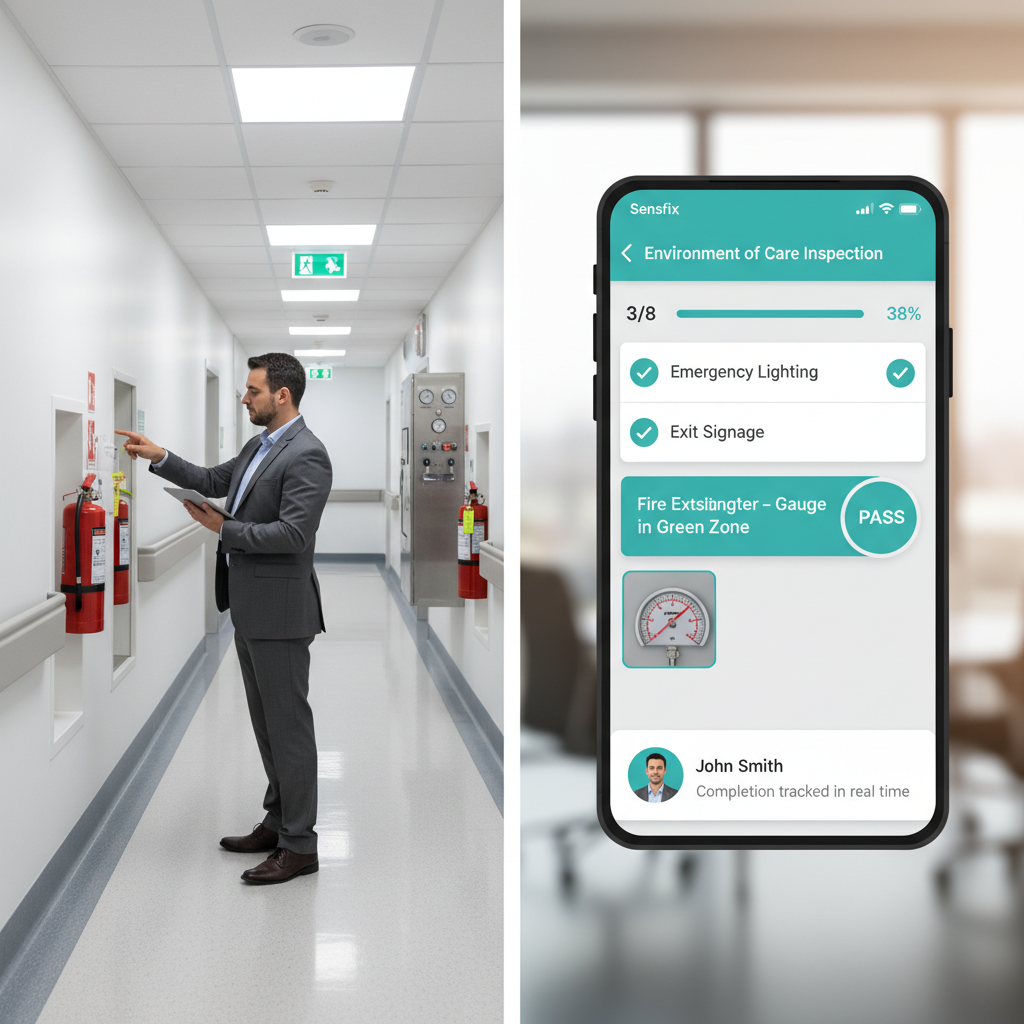
The Problem
Every hospital must conduct regular EOC rounds for Joint Commission and CMS compliance. The average time to classify and dispatch a maintenance issue is 21 minutes (JLL industry benchmark). Paper-based inspections miss 60% of equipment failures and create audit liability with no photographic evidence trail.
Cross-Industry Workflow Digitization Results
| Deployment | Scope | Result |
|---|---|---|
| Theatro/World Market | Voice-directed workflows | 12% average time savings per associate; 77% improvement in speed of service |
| Honeywell Voice | 35+ languages, ~1M workers daily | Up to 35% productivity increase; 99.99%+ accuracy; 85% reduction in training time |
| Sensfix at European retail chain | Equipment defect detection | Defective lights, empty equipment, and appliance failures detected with maintenance tickets auto-generated |
From Paper Checklists to AI-Verified Digital Rounds
TaskflowDigitizerAI digitizes any inspection procedure — fire extinguisher checks, medical gas panel rounds, crash cart verifications, safety inspections. Staff swipe through steps, capture photo/video evidence, and facility managers monitor completion in real time.
ReportAI classifies issues in seconds (vs. 21-minute JLL benchmark). FormifyPro creates custom JCI/CMS inspection forms. Multimodal Rule Engine automates dispatch and escalation. Proven at Sensfix’s European retail chain for equipment defect detection and automated maintenance ticket generation.
Sterile Processing & Instrument Verification
The Problem
26% of surgical cases involve at least one sterile instrument error at studied university hospitals, costing $6.75M–$9.42M annually in non-recoverable OR time. Manual instrument identification requires extensive training and is prone to human error under time pressure, with missing or incorrect instruments discovered only when the case has already begun.
Surgical Instrument AI Deployments
| Deployment | Scope | Result |
|---|---|---|
| LayerJot at multiple U.S. hospitals | CV-based instrument identification & tray assembly verification | $500K–$3M annual savings; 30–70% reduction in instrument volume per tray |
| Censis CensisAI² | 1,300+ hospitals | 20% improvement in tray processing efficiency using the same staff |
| IDENTI Medical Snap&Go | AI camera for surgical implant capture | 30% improvement in charge capture; 97.3% reduction in expiry wastage; 3 seconds per scan |
Object Recognition from Retail to Sterile Processing
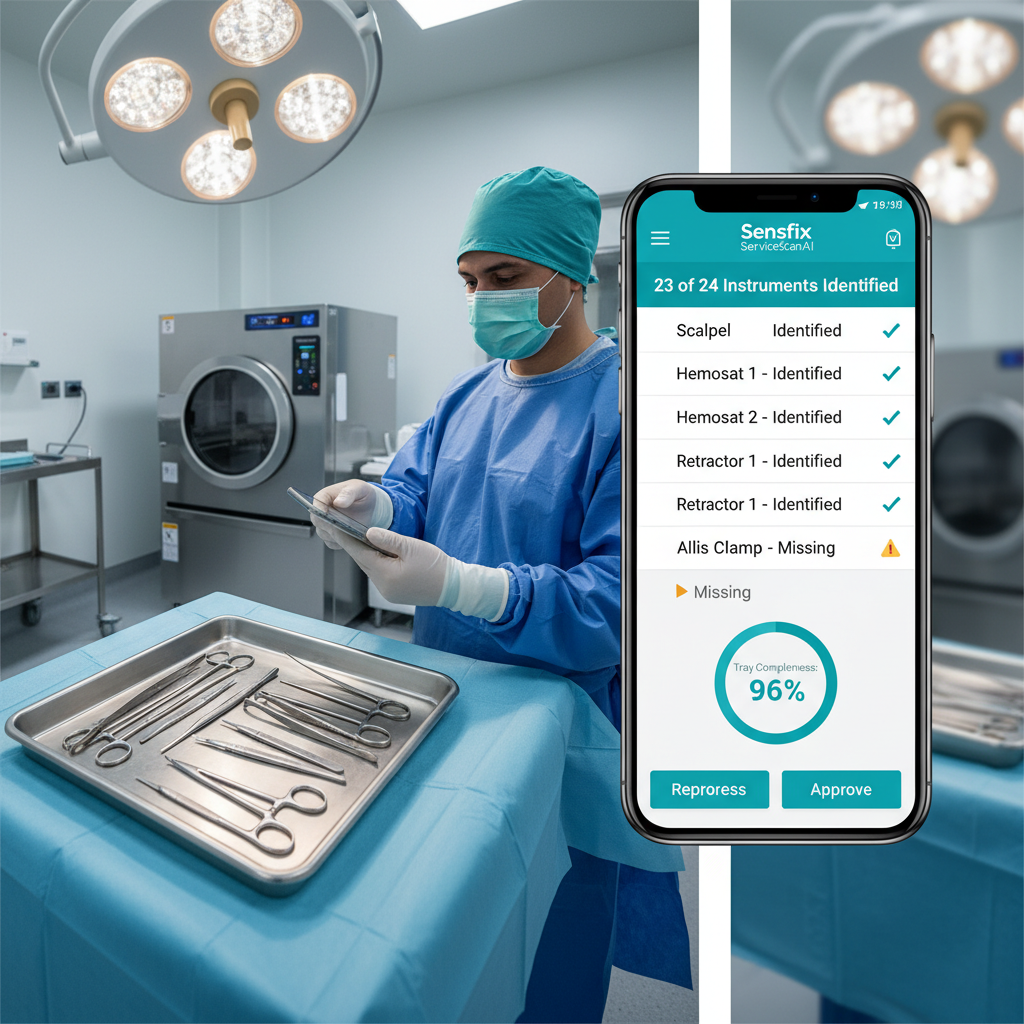
ServiceScanAI visually verifies tray completeness via smartphone camera — extending the same object recognition capabilities proven at Sensfix’s European retail chain for product and equipment identification. FormifyPro provides sterile processing audit forms.
TaskflowDigitizerAI digitizes step-by-step reprocessing workflows with photo evidence at each stage. Unlike dedicated sterile processing vendors, Sensfix also monitors the broader central sterile supply department environment — cleanliness, equipment status, workflow compliance.
OR Utilization & Turnover Monitoring
The Problem
Operating rooms generate 40–60% of hospital revenue but run at only 60–70% utilization. Only 8.3% of surgeries are manually recorded; without systematic monitoring, hospitals cannot link intraoperative events to outcomes or optimize scheduling. Every minute of OR downtime costs $36–$62 in lost revenue.
OR Analytics Deployments at Scale
| Deployment | Scope | Result |
|---|---|---|
| Artisight | 1,000+ ORs, trained on 500,000+ procedures across 50+ specialties | 16x ROI; 5–6% increase in surgical volume; zero-click EHR documentation |
| LeanTaaS iQueue | 175+ health systems (4,600+ ORs) | CommonSpirit Health: $40M ROI in 18 months; OHSU: 20% increase in block utilization |
| Theator at Mount Sinai | Surgical video intelligence | From 122 recorded procedures in 10 years to 163 in one year; 56% increase in safety milestone adoption; 13% decrease in operative time |
Environmental Intelligence That Complements Clinical Systems
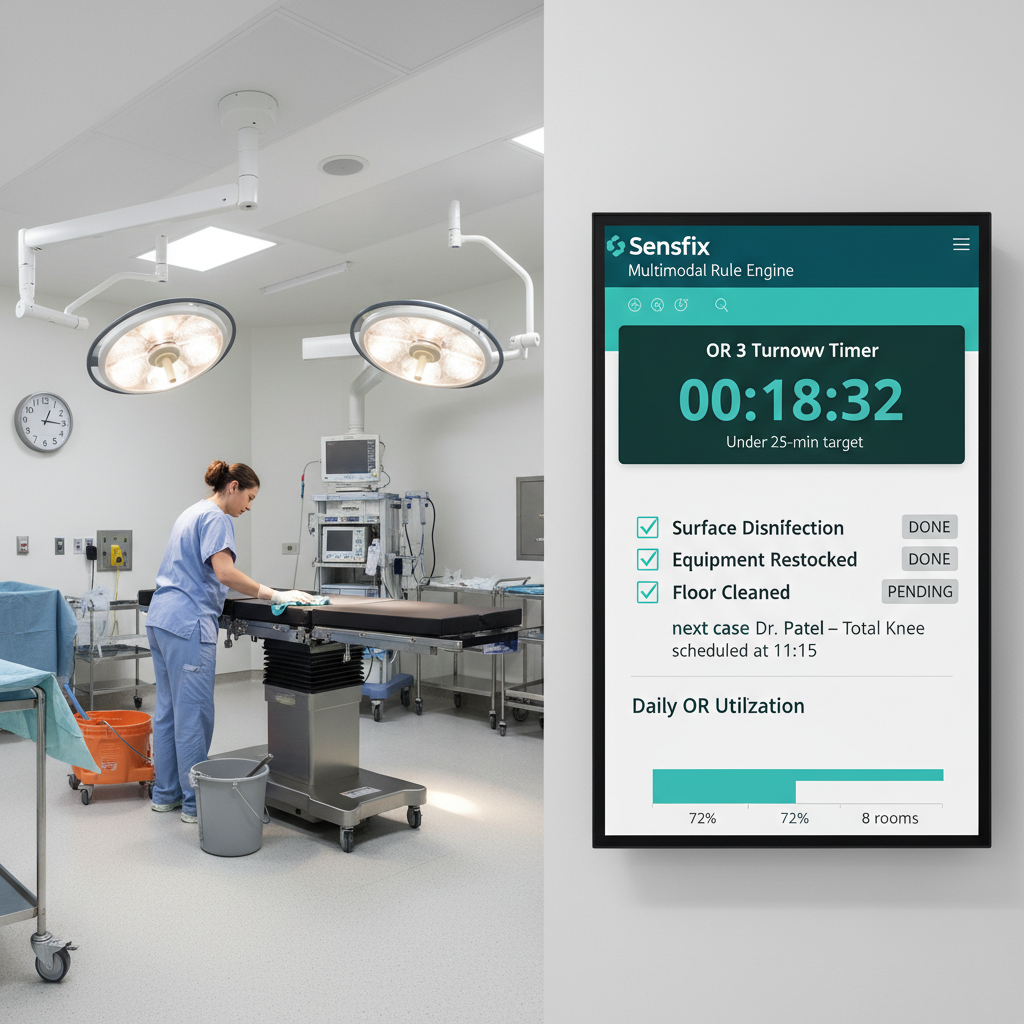
ServiceScanAI monitors OR turnover and readiness via existing CCTV — extending the same real-time environmental monitoring proven at Sensfix’s European retail chain for zone readiness and equipment staging. Multimodal Rule Engine triggers ‘If OR not cleaned 30 min post-case THEN alert EVS’ logic.
TaskflowDigitizerAI provides OR preparation checklists with photo evidence. The same platform monitors the OR environment alongside clinical systems, providing operational insights that complement surgical video vendors.
Food Service Waste Reduction & Kitchen Safety
The Problem
U.S. hospitals generate an estimated 2.2 million tons of food waste annually. A 200-bed hospital typically wastes $100,000–$300,000 in food per year. Kitchen safety violations create regulatory exposure and patient risk, while food costs represent 3–5% of total hospital operating expenses.
Hospital Food Waste AI Deployments
| Deployment | Scope | Result |
|---|---|---|
| Leanpath at Gundersen Lutheran (Wisconsin) | AI camera + smart scale | 50% waste reduction in 8 months ($25K saved); eventually ~70% of baseline waste eliminated |
| Leanpath at UCSF Hospital | AI food waste tracking | $60,000 saved over 2 years with 35% waste reduction |
| Winnow Solutions | 3,000+ commercial kitchens, 77 countries | 40–70% waste reduction; 2–8% food cost savings |
The Entire Kitchen Environment from One Platform
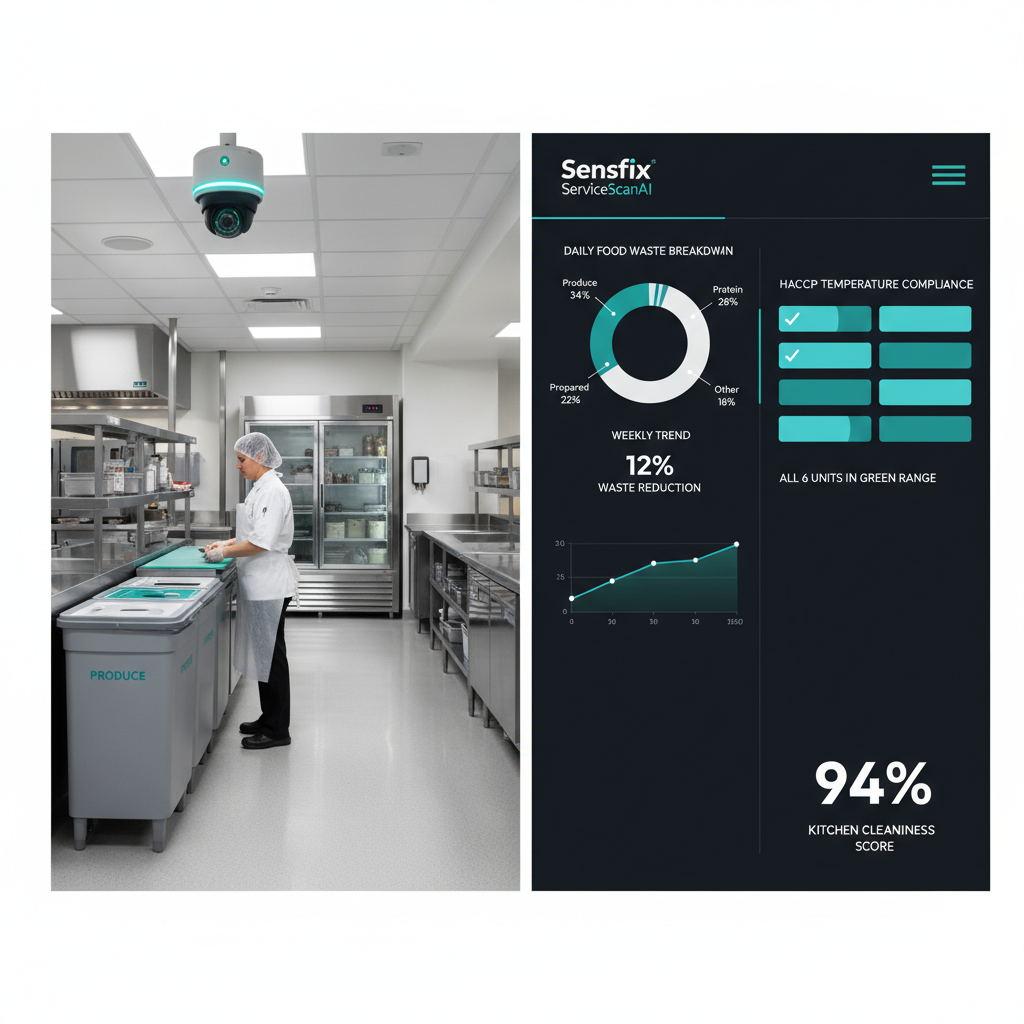
ServiceScanAI monitors kitchen cleanliness, food prep areas, and waste via CCTV or mobile — the same visual compliance monitoring proven at Sensfix’s European retail chain for continuous floor and equipment condition tracking.
ServiceOCRPro reads refrigerator/freezer temperature gauges via smartphone camera for HACCP compliance. Multimodal Rule Engine triggers ‘If temperature gauge out of range THEN alert kitchen manager’ logic. FormifyPro provides dietary compliance audit forms. Unlike food-waste-only vendors, Sensfix monitors the entire kitchen environment — cleanliness, equipment, prep compliance, and waste — from one platform.
Campus Security & Weapon Detection
The Problem
Hospital workplace violence affects 73% of healthcare workers (BLS), with over 50% of gun violence at healthcare facilities occurring inside the building. Healthcare workers are 5x more likely to experience workplace violence than workers in other industries. Workplace violence incidents have surged 63% since 2018. California's AB 2975 mandates hospital weapons detection by March 2027.
Hospital Security Technology Deployments
| Deployment | Scope | Result |
|---|---|---|
| Evolv Technology (AHA Preferred Provider, Feb 2026) | 500+ hospital buildings; 900,000+ visitors/staff screened daily | Concealed weapon detection screening up to 4,000 people/hour |
| Temple University Health (Philadelphia) | Weapon detection since June 2023 | 500+ guns and 200+ knives stopped |
| Windsor Regional Hospital (Ontario) | Weapon detection since October 2023 | 1,000+ weapons detected |
| ZeroEyes at JPS Health Network (Fort Worth) | 582-bed Level I Trauma Center | AI gun detection on existing cameras with alerts in 3–5 seconds |
Environmental Safety That Complements Dedicated Screening
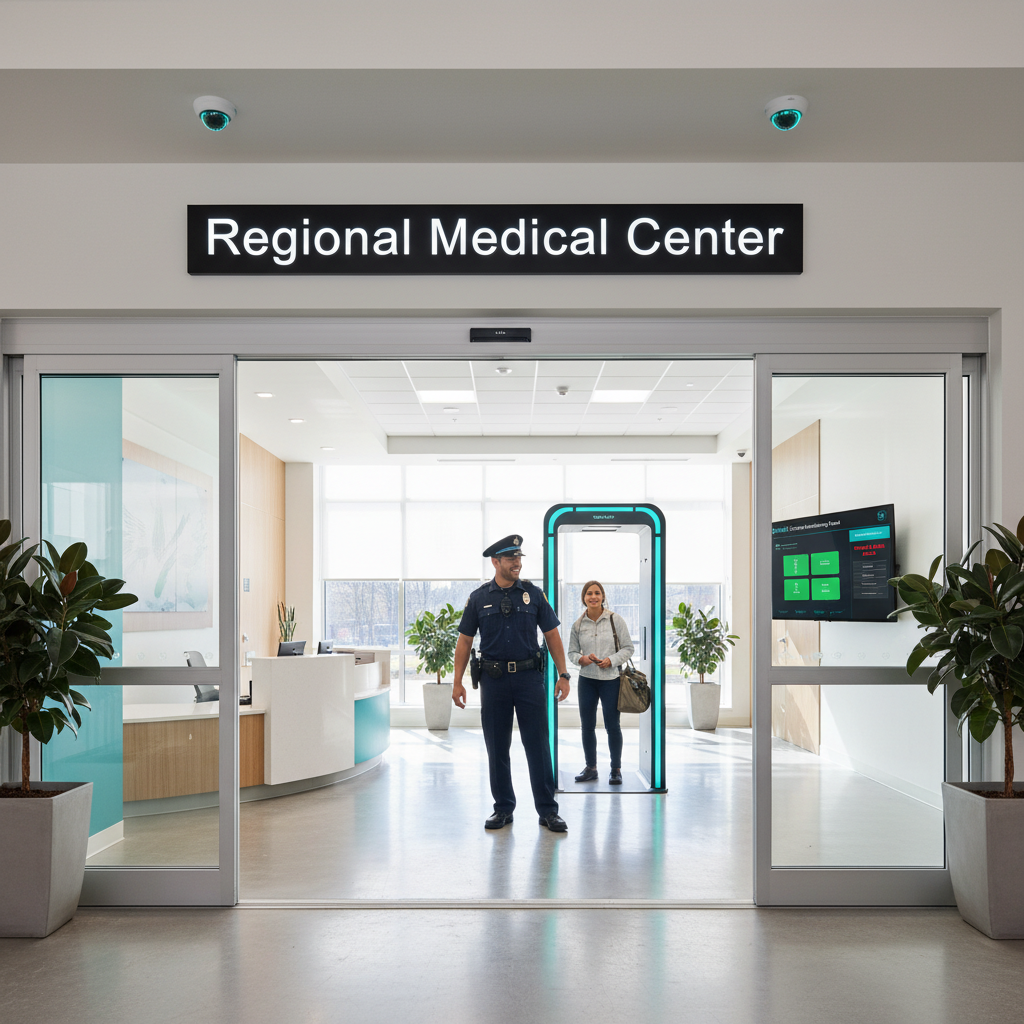
ServiceScanAI provides CCTV-based perimeter and restricted area monitoring — extending security monitoring capabilities proven at the Port of Tampa with <1% error rate. Multimodal Rule Engine triggers ‘If unauthorized access to restricted zone THEN alert security’ logic.
ReportAI enables staff to report security concerns via mobile with instant classification and routing. Sensfix adds an environmental safety layer (hallway obstructions, lighting defects, exit blockages) that complements dedicated weapon detection systems.
Parking & Wayfinding Optimization
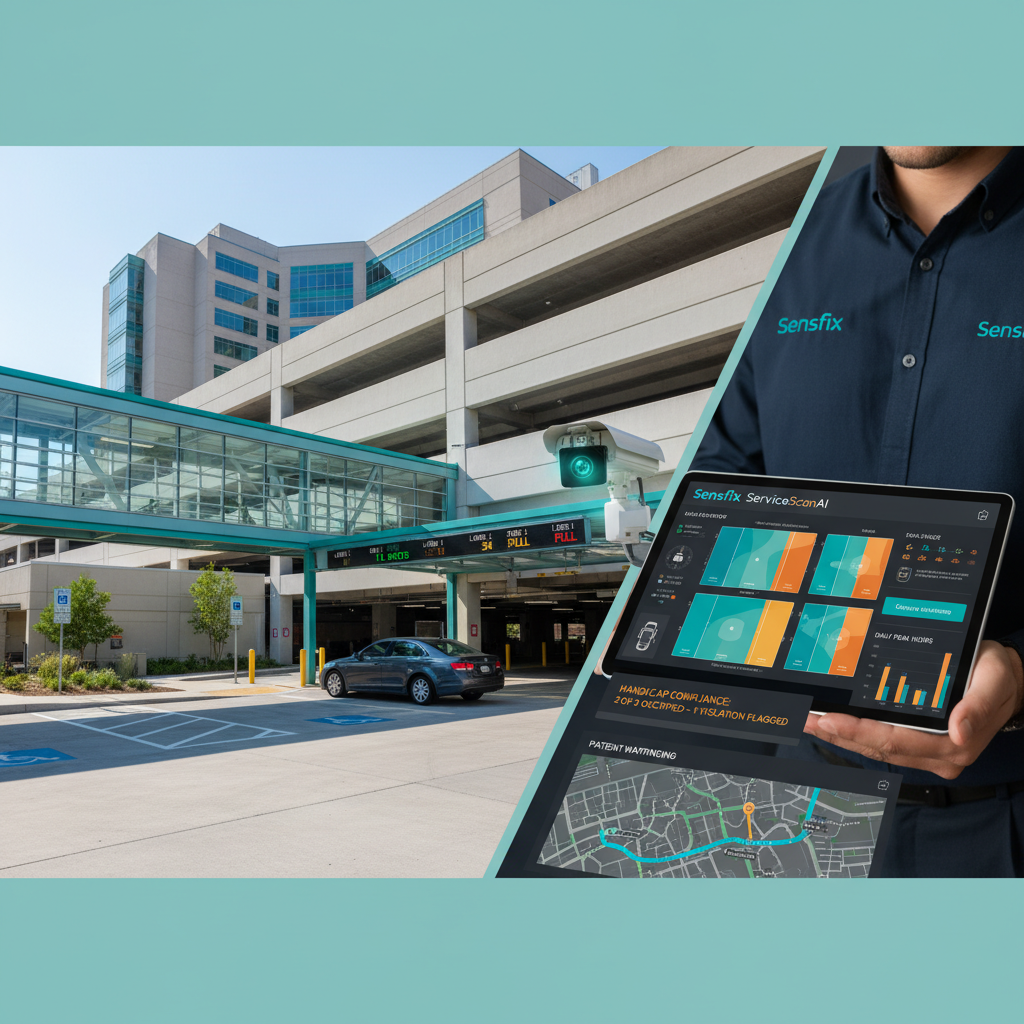
The Problem
76% of patients rate parking as the lowest-scoring hospital service. Poor parking experiences increase patient no-show rates and negatively impact HCAHPS scores. Parking structure expansions cost millions, yet existing capacity is often underutilized due to poor real-time information.
Healthcare Parking Technology Deployments
| Deployment | Scope | Result |
|---|---|---|
| Seattle Children’s Hospital (Parking Logix) | Sensor-based parking counting | Reduced circling traffic; improved patient arrival experience |
| Cleverciti at hospital campuses | AI sensors covering up to 100 spaces each | 900%+ ROI; $4M+ NPV for a 1,000-space campus |
| Nwave at healthcare facilities | Wireless parking sensors with cloud analytics | 30–40% reduction in average time-to-park |
Beyond Single-Purpose Parking Sensors
ServiceScanAI monitors parking occupancy and campus conditions via existing CCTV cameras — the same visual detection platform used across Sensfix’s enterprise deployments. Multimodal Rule Engine triggers ‘If handicap space blocked > 5 min THEN alert’ logic.
FormifyPro provides campus condition assessment forms. One platform monitors parking, walkway safety, building exterior condition, and lighting status — not a single-purpose parking sensor.
Pressure Injury Prevention & Wound Monitoring
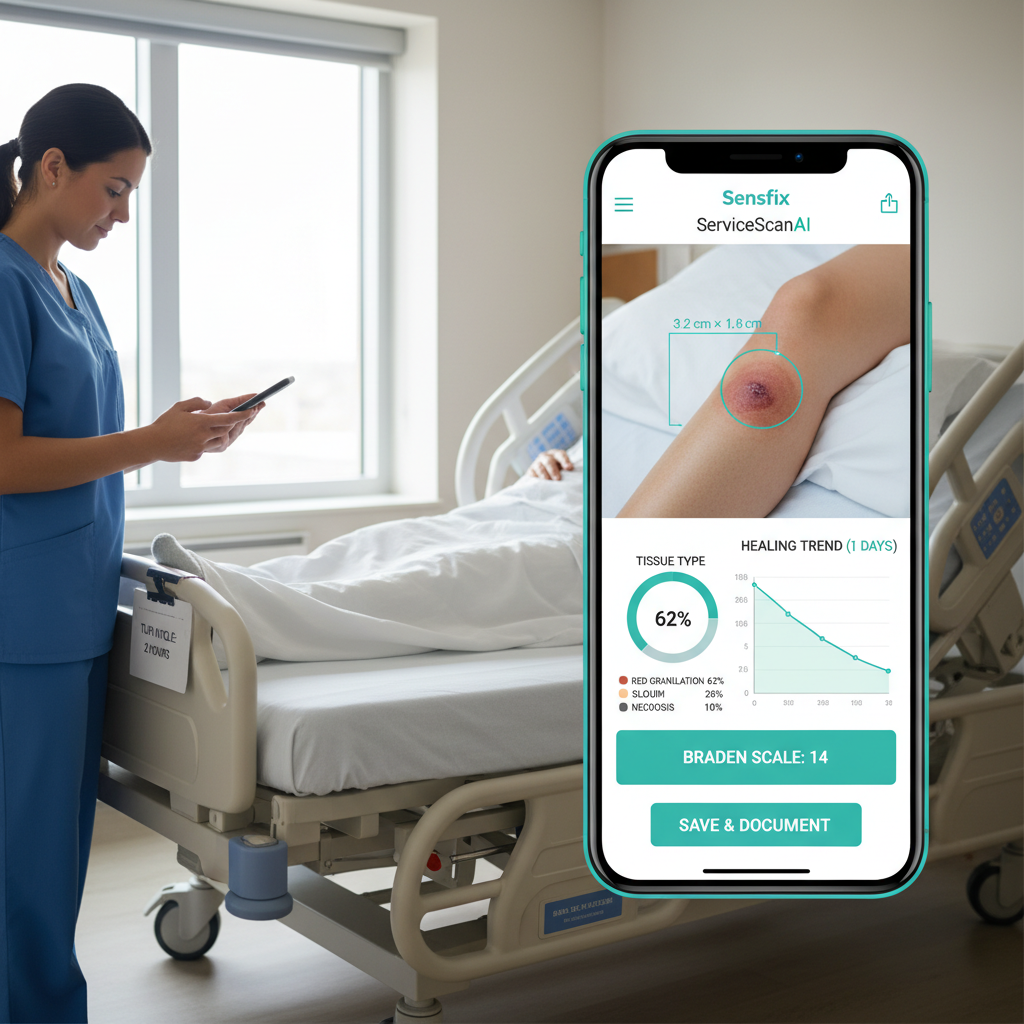
The Problem
Pressure injuries cost U.S. healthcare $26 billion+ during hospitalization and contribute to approximately 60,000 deaths annually. Nurses use the subjective Braden Scale every 12 hours with poor predictive validity. Manual wound measurement with paper rulers and cotton swabs is imprecise and inconsistent across caregivers.
Clinical Wound AI Deployments
| Deployment | Scope | Result |
|---|---|---|
| Swift Medical (Toronto) | 4,800+ facilities; 32M+ calibrated wound images | 37% faster wound healing; 35% reduction in wound prevalence; 14% reduction in hospitalizations; 62% reduction in hospital length of stay |
| Kepler Vision Night Nurse | UZ Brussel & care facilities | Continuous lying-position detection for repositioning compliance monitoring |
| CareAI | 1,800+ care facilities | Ambient pressure injury risk monitoring at scale |
Mobile CV Extended to Clinical Documentation
ServiceScanAI extends smartphone-based visual assessment capabilities to wound documentation — building on the same mobile CV platform proven across Sensfix’s enterprise deployments.
TaskflowDigitizerAI digitizes repositioning protocols as step-by-step workflows with photo evidence at each turn. Multimodal Rule Engine triggers ‘If repositioning not documented within 2-hour window THEN alert nursing station’ logic. FormifyPro provides Braden Scale digital assessment forms.
Pharmacy Verification & Medication Storage Monitoring
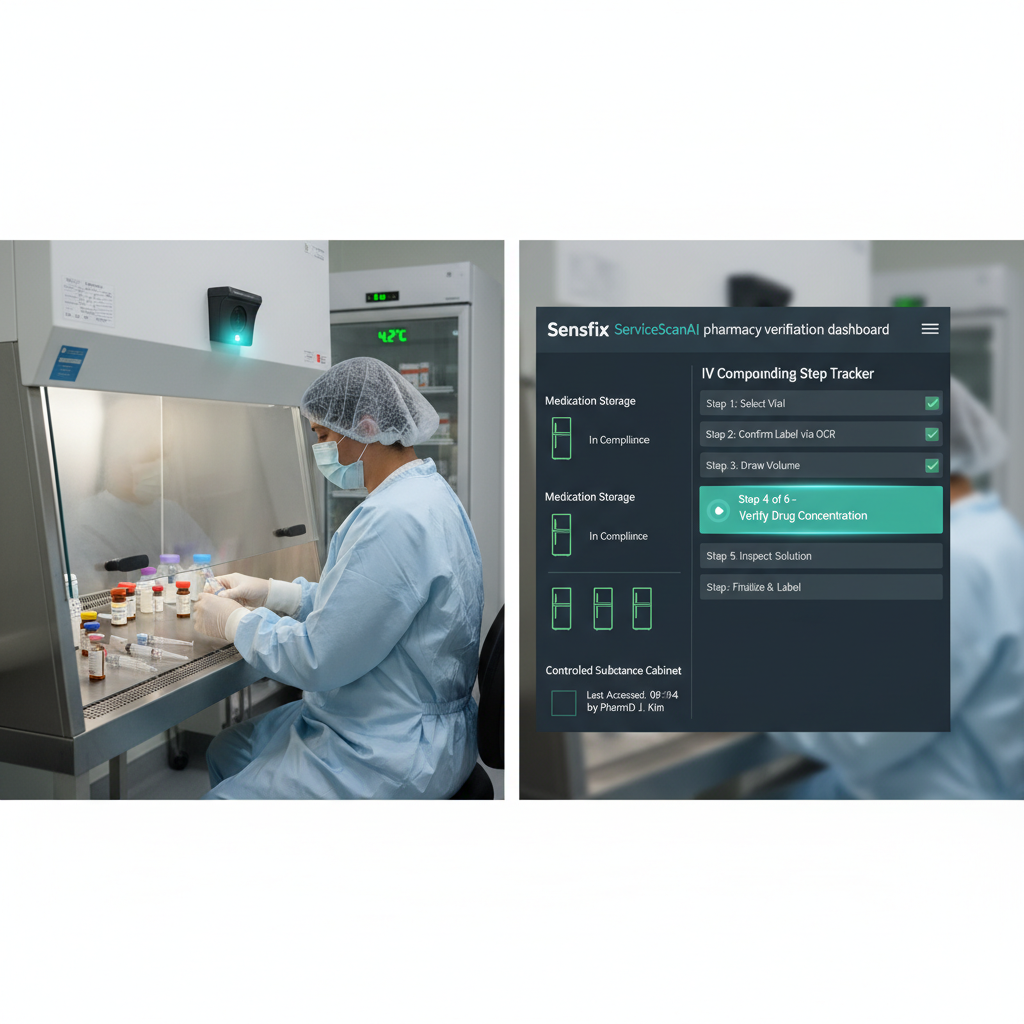
The Problem
The ISMP found manual visual verification “not effective in detecting and correcting” IV compounding errors. Pharmacy kits previously required 17 minutes of manual checking per cardiac arrest box. Medication errors contribute to approximately 7,000–9,000 deaths per year in the U.S., with compounding errors among the highest-risk categories.
Pharmacy AI Verification Deployments
| Deployment | Scope | Result |
|---|---|---|
| BD Pyxis IV Prep at 535-bed NY hospital | Camera-based visual documentation per compounding step | Zero IV room audit findings during latest Joint Commission visit |
| Bluesight (formerly Kit Check) | 1,000+ hospitals | RFID-based pharmacy kit verification in seconds vs. 17 minutes |
| Brigham and Women’s Hospital | Dose scanning | Over 1 million doses scanned with no errors leaving the pharmacy |
| Michigan Medicine | Cardiac arrest box verification | Filled in 4 minutes vs. 17 previously |
The Entire Pharmacy Environment, Not Just One Function
ServiceScanAI provides camera-based visual verification for compounding and storage areas — extending the same visual inspection capabilities proven at Sensfix’s European retail chain for equipment and compliance monitoring.
ServiceOCRPro reads temperature displays on medication refrigerators and controlled substance storage units via smartphone camera. Multimodal Rule Engine triggers ‘If temperature out of range THEN alert pharmacy manager’ logic. TaskflowDigitizerAI digitizes pharmacy verification SOPs with photo evidence. The same platform monitors the entire pharmacy environment — not just one function.
Alarm Fatigue Reduction & Audio Monitoring
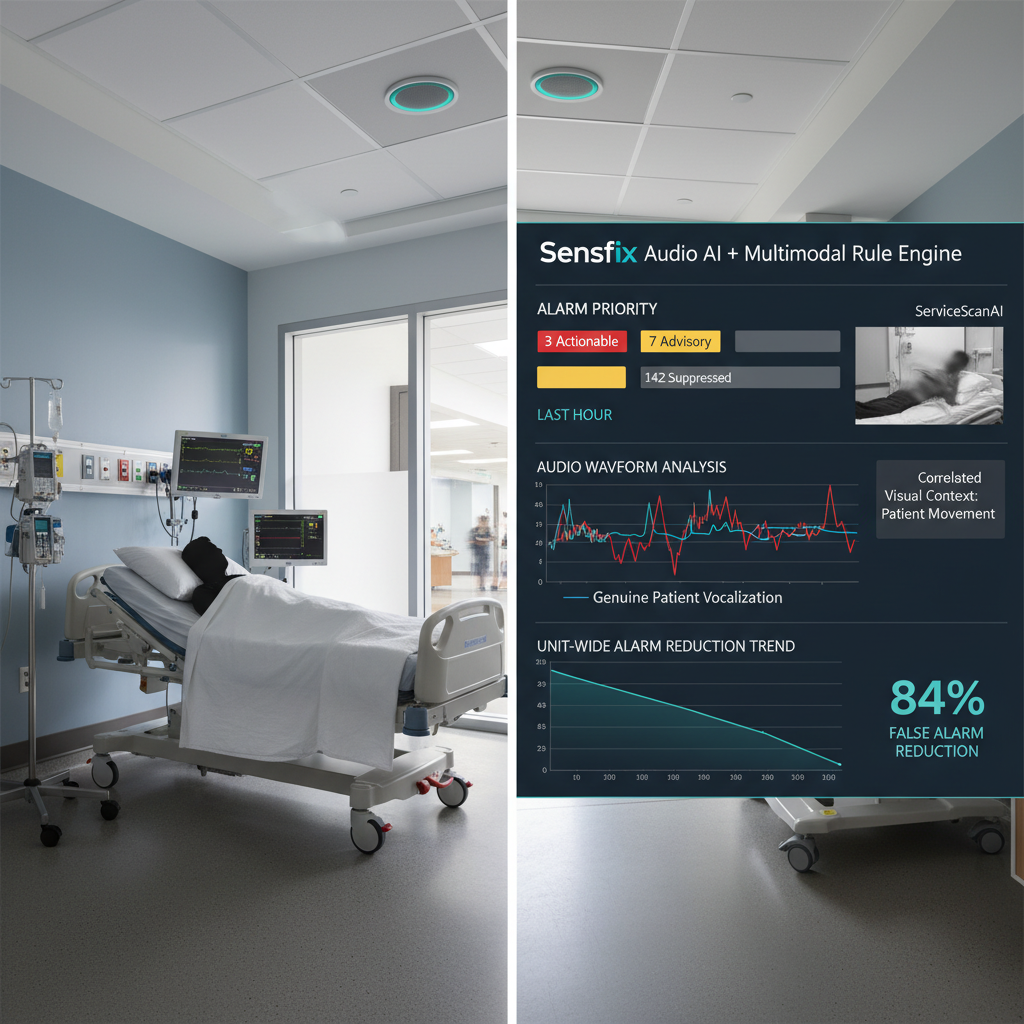
The Problem
80–99% of ICU alarms are false or clinically insignificant. ECRI Institute has repeatedly listed alarm hazards among the top health technology hazards. Alarm fatigue leads to desensitization, with clinicians missing critical events among hundreds of daily non-actionable alerts.
Clinical Alarm Management Deployments
| Deployment | Scope | Result |
|---|---|---|
| CalmWave AI at Wellstar Health System | ICU proof-of-concept | 58% reduction in non-actionable alarms using explainable AI |
| Masimo Patient SafetyNet at Dartmouth-Hitchcock | 10+ year study | 65% reduction in rapid response team activations; 48% reduction in ICU transfers; zero preventable deaths due to opioids; $1.48M/year cost savings |
| Sound Intelligence (Netherlands) | 20+ years of AI-powered ambient sound analysis | Aggression and distress detection at scale |
Multimodal AI: Audio + Visual for Higher-Confidence Alerting
Audio AI Rule Engine analyzes ambient sound patterns for genuine distress indicators — extending the same sound anomaly detection technology proven at the world’s 2nd-largest train manufacturer for compressor monitoring.
Multimodal Rule Engine correlates audio events with visual context from ServiceScanAI for higher-confidence alerting. The combination of audio + visual AI reduces false positives while catching genuine events that single-modality systems miss.
Neonatal & Infant Security Monitoring
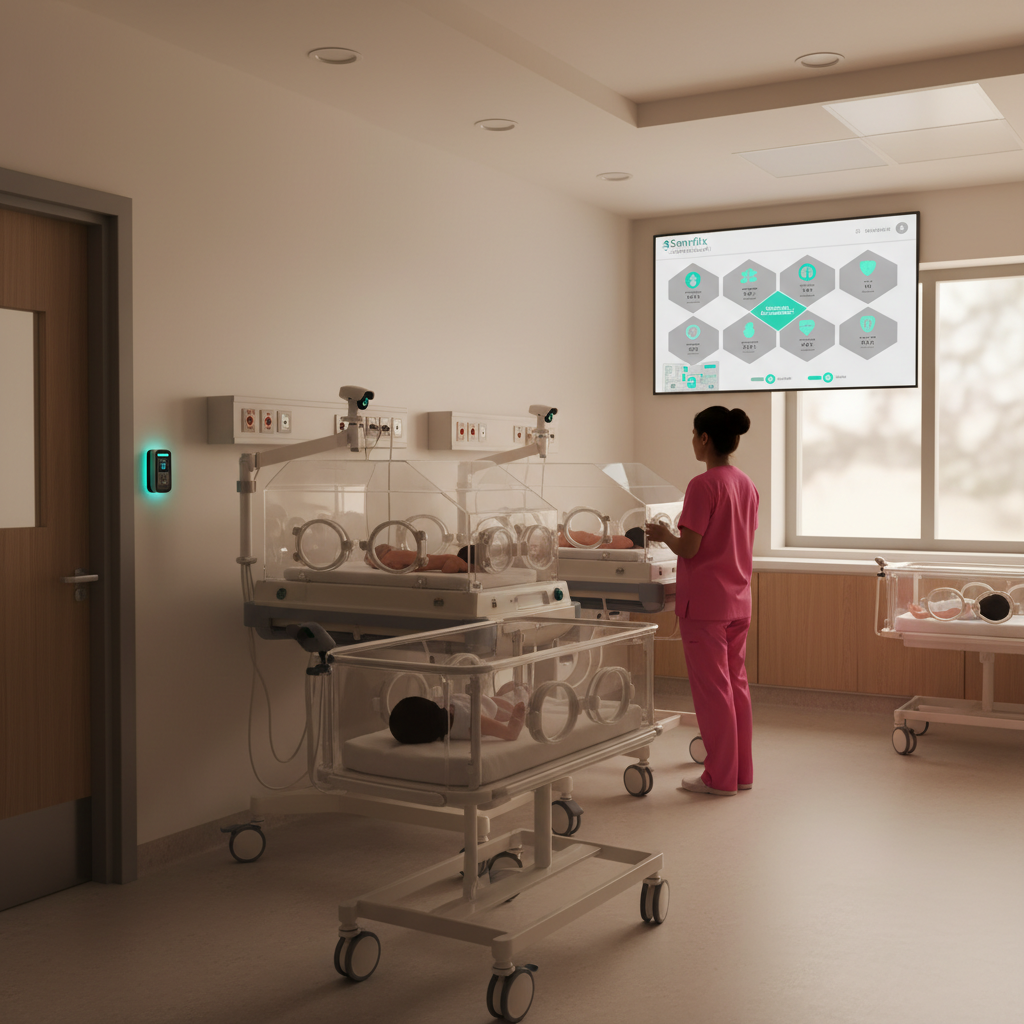
The Problem
Infant abduction attempts, though rare, remain a critical security concern: approximately 120 infants have been abducted from healthcare facilities since 1965. NICU monitoring traditionally relies on wired sensors that restrict infant movement and require frequent repositioning by nurses, consuming valuable care time.
NICU AI Technology Deployments
| Deployment | Scope | Result |
|---|---|---|
| AngelEye Health (Nashville) | ~10,000 bedside cameras across 300+ hospitals | Transforming passive NICU viewing cameras into intelligent clinical assets |
| Mount Sinai ‘Pose AI’ | 16.9M seconds of video from 115 NICU infants | First-ever continuous neuro-telemetry via video in the NICU (published in The Lancet eClinicalMedicine, Nov 2024) |
| Flinders Medical Centre (Australia) | CV for premature infant vital signs | Matched ECG accuracy for heart rate and respiratory rate |
Security and Environmental Monitoring for Sensitive Zones
ServiceScanAI can monitor nursery and NICU environments via existing cameras for security and environmental compliance. Multimodal Rule Engine triggers ‘If unauthorized access to nursery zone THEN alert security + nursing station’ logic.
TaskflowDigitizerAI provides infant care workflow documentation with photo evidence. The platform’s security monitoring capabilities — proven at the Port of Tampa — extend naturally to sensitive hospital zones.
Ambulance Bay & Loading Dock Monitoring
The Problem
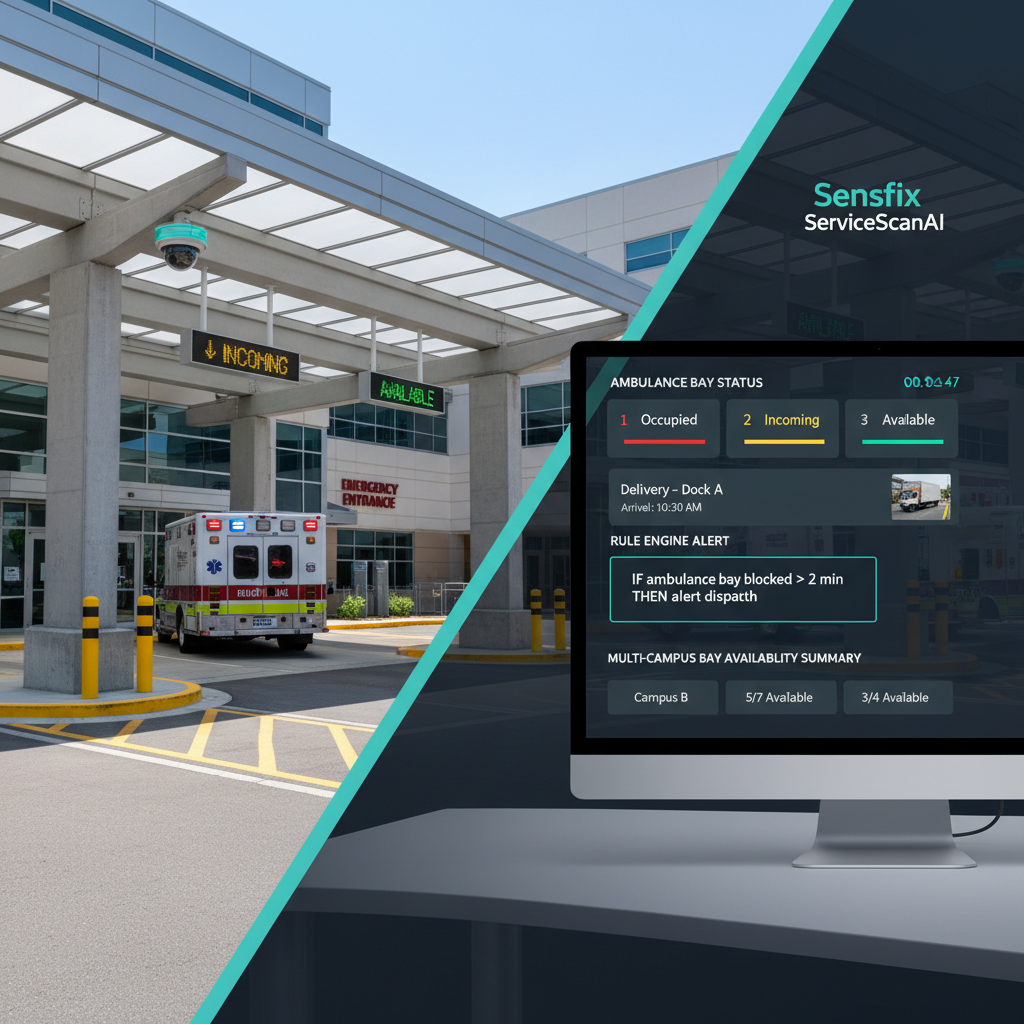
Ambulance diversion costs U.S. emergency departments an estimated $4 billion annually in lost revenue and delayed patient care. Loading dock inefficiency and supply chain disruptions cost hospitals $5,000–$15,000 per incident in delayed procedures and emergency reorders. Blocked ambulance bays directly endanger patient lives by delaying emergency response.
A First-Mover Opportunity
No published peer deployment specifically for AI-powered ambulance bay monitoring in U.S. hospitals. However, Cypress Creek EMS (Houston) deployed body-worn cameras with live-streaming in ambulances, and the Port of Tampa (Sensfix deployment) demonstrates the same camera-based vehicle and loading zone monitoring capabilities applicable to hospital loading docks.
Proven Industrial Monitoring Applied to Hospital Logistics
ServiceScanAI monitors ambulance bay occupancy and loading dock activity via existing CCTV — the same vehicle and zone monitoring capabilities proven at the Port of Tampa with <1% error rate.
Multimodal Rule Engine triggers ‘If ambulance bay blocked > 2 min THEN alert dispatch’ and ‘If delivery at dock THEN notify receiving’ logic. TaskflowDigitizerAI documents supply receiving workflows with photo evidence. A natural extension of Sensfix’s proven industrial monitoring into hospital logistics.
Wandering & Elopement Prevention
The Problem
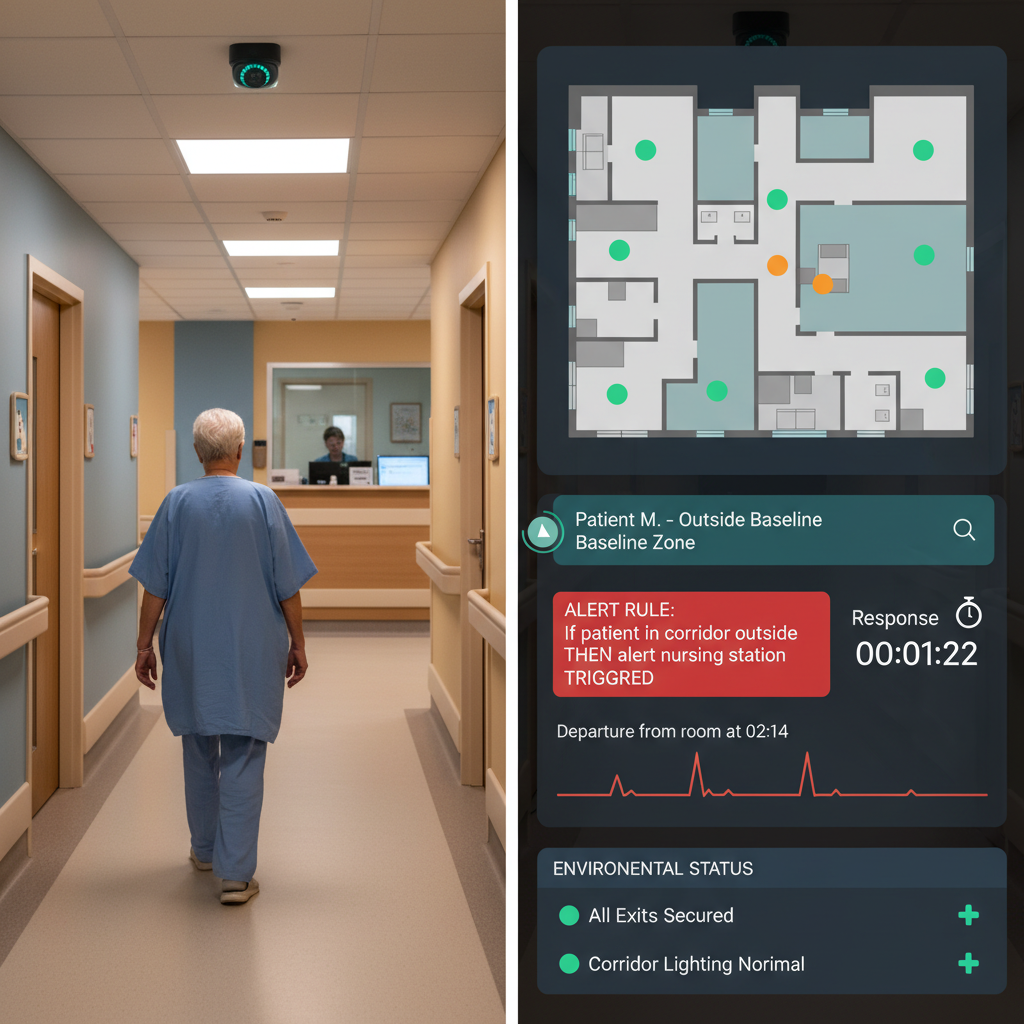
60% of dementia patients experience at least one wandering episode. Elopement from psychiatric units is a leading cause of sentinel events reported to The Joint Commission. Traditional door alarms only alert after the patient has already exited, providing minimal time for intervention.
Patient Monitoring Technology Deployments
| Deployment | Scope | Result |
|---|---|---|
| Royal Melbourne Hospital (Australia) | AI camera systems | Tracks movement anomalies against each patient’s baseline behavior; alerts while patient is still in the corridor |
| Kepler Vision Night Nurse | UZ Brussel | Detects room exits and bathroom overstays |
| AvaSure virtual monitoring | 1,200+ hospitals | Specifically deployed for elopement prevention in psychiatric units and dementia wards |
Zone Monitoring from Retail to Patient Care
ServiceScanAI extends CCTV-based movement pattern detection to patient corridors and ward exits — leveraging the same zone monitoring and anomaly detection capabilities proven at Sensfix’s European retail chain for restricted area monitoring.
Multimodal Rule Engine triggers ‘If patient in corridor outside baseline pattern THEN alert nursing station’ logic. The platform provides environmental context (lighting, obstructions, exit status) alongside patient movement data.
Issue Management & Classification
The Problem
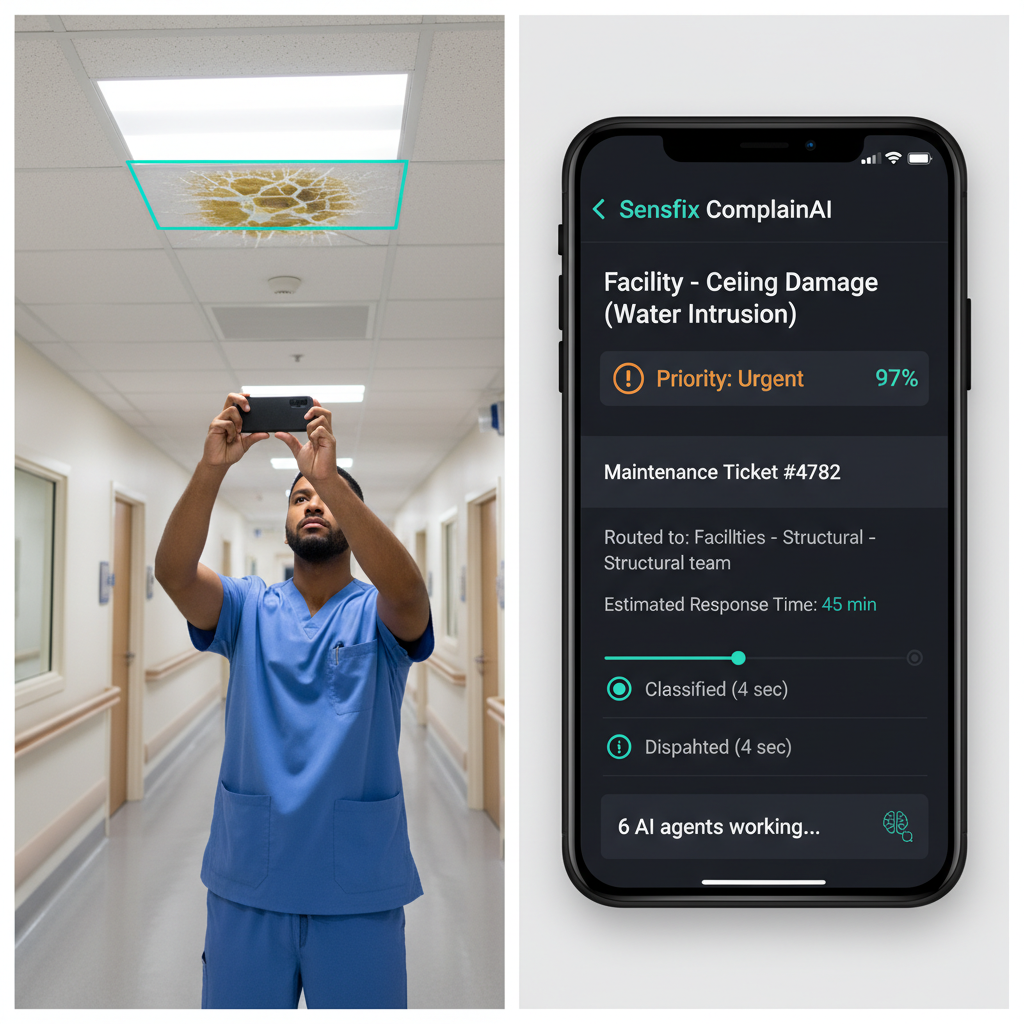
The average time to receive, classify, and dispatch a maintenance issue is 21 minutes (JLL industry benchmark). Patient reported issues about facility conditions (cleanliness, temperature, noise, broken equipment) directly impact HCAHPS scores and CMS reimbursement. Manual issue triage creates bottlenecks and inconsistent response times.
Proven Sensfix Deployment Results
| Deployment | Scope | Result |
|---|---|---|
| Sensfix ReportAI | 46 enterprise clients across 3 continents | AI chatbot classifies issues in seconds, replacing the 21-minute manual classification benchmark |
| Sensfix at European retail chain | Commercial buildings across 3 continents | Automated issue classification and ticket routing at enterprise scale |
From 21 Minutes to Seconds \u2014 Already Proven
ReportAI is Sensfix’s purpose-built product for this use case — staff scan an issue with their smartphone, AI chatbot classifies it in seconds, and a ticket is created and routed automatically. Already proven with 46 enterprise clients across 3 continents.
6 AI agents work autonomously on classification, routing, and escalation. Funded by a $2.5M international R&D Grant — the world’s first multimodal rule engine. Patient reported issues about facility conditions directly impact HCAHPS scores; ReportAI ensures every issue is captured, classified, and resolved with full audit trail.
Transfer Capability Matrix
Every capability listed below is production-proven. The third column shows how each maps to hospital operations domains documented above.
| Capability | Where Proven | Hospital Application |
|---|---|---|
| 42+ defect detection models (0.2mm resolution) | Industrial facilities, 3 continents | Floor hazards, equipment defects, facility condition, wound edges |
| Audio AI for rotating machinery health | World's 2nd-largest train manufacturer (compressors) | HVAC compressors, elevator motors, laundry equipment, alarm sound classification |
| Automated gauge/meter OCR (99%+ accuracy) | Cadagua wastewater facility | Medication storage temps, generator gauges, pool chemical readings, HVAC panels |
| Safety zone enforcement & PPE detection | US Gulf Coast port (production) | Hand hygiene compliance, kitchen PPE, restricted area monitoring, perimeter security |
| Multi-site compliance dashboards | European retail chain (4,600+ stores) | EOC rounds, JCI/CMS compliance, infection control audits, multi-facility reporting |
| Digital workflows + 80% parts savings | Bay Area automaker | Sterile processing SOPs, OR prep checklists, maintenance workflows, pharmacy verification |
| Real-time vehicle tracking (<1% error) | US Gulf Coast port (production) | Ambulance bay monitoring, loading dock activity, parking occupancy |
| People counting & dwell-time analytics | Commercial building portfolios, 3 continents | Patient fall detection, wandering prevention, staff deployment, OR utilization |
| AI-powered issue classification (seconds vs. 21 min) | 46 enterprise clients globally | Patient/staff reported issues, maintenance requests, HCAHPS-impacting issues |
| Baseline comparison (image-to-image) | Bay Area automaker (vehicle body panels) | Instrument tray verification, wound progression tracking, facility condition changes |
| Process monitoring & coverage verification | Industrial quality control (3 continents) | Hand hygiene events, cleaning compliance, food safety, pharmacy compounding |
| Zone monitoring & anomaly detection | Port safety zones + European retail chain | Elopement prevention, NICU security, restricted area access, campus perimeter |
Implementation Approach
Phase 1: Guided Evaluation (Up to 90 Days)
A structured evaluation where Sensfix deploys the SAAI Suite on two selected use cases under a dedicated services agreement. This phase includes full platform deployment, AI model configuration for hospital-specific conditions, and comprehensive reporting, ensuring the health system can evaluate real-world performance with rigor before committing to facility-wide deployment.
Pilot A: Facility Inspection & Compliance Digitization
Deploy TaskflowDigitizerAI for EOC rounds on one floor or wing. Staff execute digital inspection workflows with photo evidence. Deliverable: comparative report showing digital vs. paper-based inspection coverage, issue detection rate, and response time improvement.
Pilot B: Issue Classification & Cleanliness Monitoring
Deploy ReportAI for facility issue classification plus ServiceScanAI on existing CCTV for corridor cleanliness monitoring. Deliverable: classification speed improvement (vs. 21-minute JLL benchmark), HCAHPS-relevant issue capture rate, and EVS response time data.
Phase 2: Enterprise SaaS Deployment
Following successful evaluation, Sensfix deploys as a facility-wide or health system-wide SaaS platform under an annual agreement. Unlimited users, unlimited licenses, unlimited data nodes. Every facility manager, EVS worker, maintenance technician, and department head. Every camera, sensor, and mobile device. No per-user fees, no data caps. One annual platform fee designed so adoption spreads organically without procurement friction.
About Sensfix
Founded
2018 (Delaware C-Corp)
Headquarters
San Francisco, CA
CEO
Balaji Renukumar
Global Offices
San Francisco · Łódź Poland · Seoul South Korea
Enterprise Clients
46 clients across 3 continents
R&D Grant
$2.5M international R&D grant (2022), funding the world's first multimodal rule engine
Research
Stanford University, Department of Computer Science, Robotics Laboratory
Technology Partners
Google Cloud · Microsoft Azure
Key Deployments
World's 2nd-largest train manufacturer · Major European infrastructure group · Port of Tampa / Agunsa · South Korean railways · European retail chain (4,600+ stores) · Bay Area automaker