The $11 Billion Slip-and-Fall Problem
Slips, trips, and falls are not a minor workplace nuisance. According to OSHA, they are the number one cause of workplace injuries in the United States, ahead of overexertion, contact with objects, and transportation incidents. The National Safety Council estimates that slip-and-fall incidents cost American businesses more than $11 billion annually in workers' compensation claims alone. Factor in litigation costs, medical expenses beyond workers' comp, productivity losses, and the 95 million lost workdays per year attributed to these incidents, and the true economic toll is significantly higher.
Despite decades of safety programs, warning signage, and employee training, the numbers have barely moved. The reason is structural: traditional slip-and-fall prevention is fundamentally reactive. Workplace safety AI CV, computer vision powered by artificial intelligence, offers the first genuinely proactive approach, detecting hazardous conditions in real time before anyone gets hurt.
Why Traditional Prevention Falls Short
Walk through any commercial or industrial facility and you will see the standard toolkit for slip-and-fall prevention: yellow caution signs, anti-slip floor treatments, safety training posters, and scheduled cleaning rotations. These measures are not useless, but they share a critical limitation. They depend on a human being noticing a hazard and responding to it in time.
A spill on a warehouse floor at 2:00 AM will not be caught until the next cleaning rotation, or until someone steps in it. A wet surface near a loading dock entrance may persist for hours during a rainy shift because no one's assigned to monitor that specific area. A piece of debris on a factory walkway goes unnoticed because the floor inspector passed through thirty minutes ago and the debris accumulated after.
Periodic inspections, no matter how diligent, create gaps. Hazards are dynamic. They appear and change continuously. Static, schedule-based inspection systems cannot keep up.
Computer Vision: Continuous, Consistent Monitoring
The core advantage of workplace safety AI CV is that it never takes a break, never gets distracted, and never has a bad day. Computer vision systems analyze video feeds from existing cameras continuously, applying trained detection models to identify hazardous floor conditions the moment they appear.
Sensfix's ServiceScanAI module is purpose-built for visual hazard detection across facility environments. The system detects a range of conditions that contribute to slip-and-fall incidents:
- Wet floors: standing water, fresh spills, condensation, and tracked-in moisture from exterior conditions
- Spills: liquid or semi-liquid substances on walking surfaces, including oil, chemical, and food-related spills
- Debris and obstructions: materials, packaging, tools, or objects left in walkways and traffic paths
- Missing signage: absent or displaced caution signs in areas with known wet or hazardous conditions
- Damaged surfaces: cracked tiles, lifted carpet edges, uneven flooring transitions, and deteriorated anti-slip treatments
When a hazard is detected, the system generates a real-time alert that is routed directly to facility managers, cleaning crews, or safety officers, depending on the type and severity of the condition. The time between hazard appearance and human awareness drops from hours (or never) to seconds.
Applications Across Industries
Slip-and-fall risk is not confined to a single industry. It is a universal workplace hazard that manifests differently depending on the environment. Workplace safety AI CV adapts to each context because the underlying technology, visual detection of floor conditions, applies wherever people walk.
Ports and maritime facilities: Dock surfaces are exposed to weather, seawater spray, fuel spills, and heavy equipment operations. The combination of moisture, oil, and uneven surfaces creates persistent slip hazards that are difficult to manage with manual inspection alone. AI monitoring of dock areas and terminal walkways provides continuous oversight of some of the highest-risk walking surfaces in any industry.
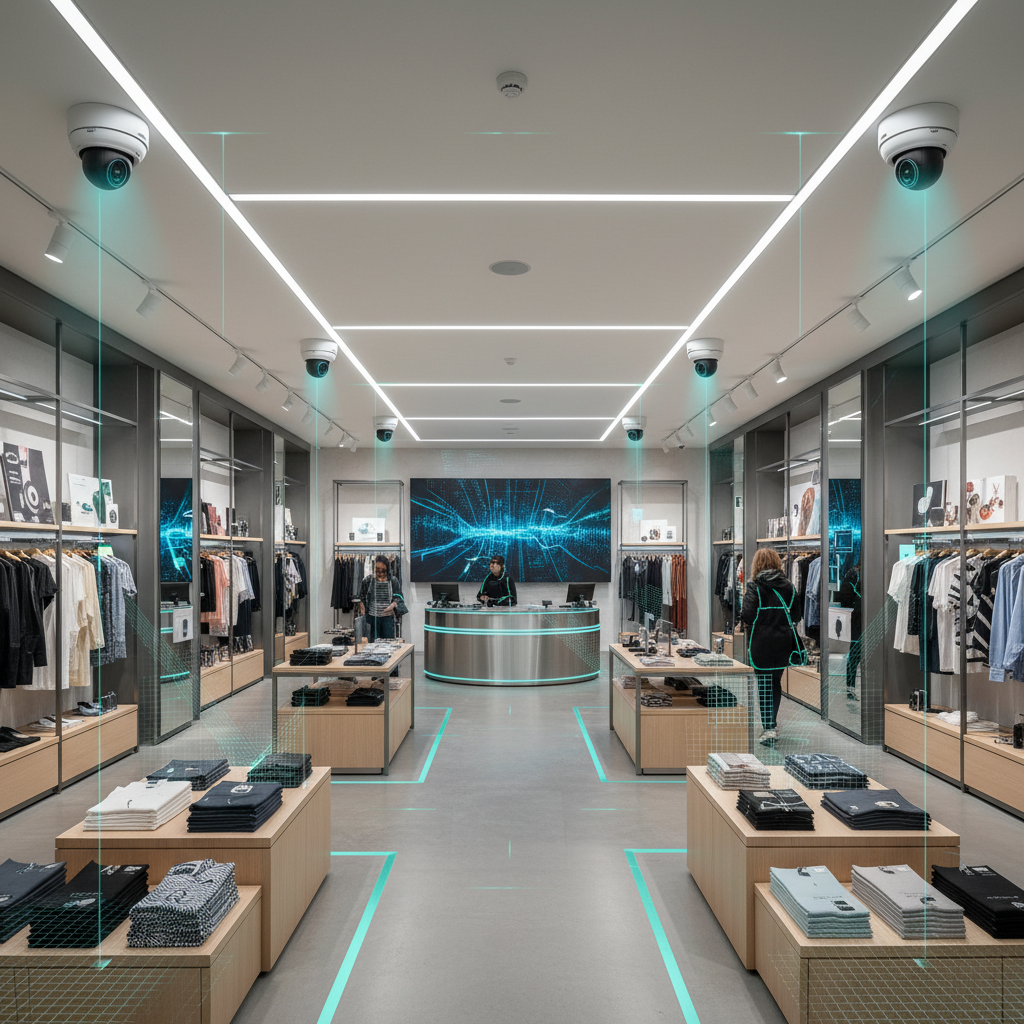
Retail environments: Customer-facing floors in grocery stores, big-box retailers, and shopping centers are constantly at risk from spills, tracked-in rain, and product breakage. A single slip-and-fall lawsuit from a customer can cost a retailer hundreds of thousands of dollars. CV systems monitoring store floors can dispatch cleaning crews to a spill within minutes of its occurrence, often before any customer encounters it.
Manufacturing and warehouses: Production areas, assembly lines, and warehouse aisles see a mix of liquid spills, oil leaks, material debris, and condensation. Forklift traffic zones and pedestrian crossings are particularly high-risk. AI-monitored hazard detection in these areas directly addresses the most common injury vector in industrial facilities.
Airports and transportation hubs: Terminal walkways, baggage claim areas, and concourses serve thousands of travelers daily. Wet weather tracking, food court spills, and restroom overflow create hazards that traditional janitorial rounds may not catch in time. AI monitoring ensures that high-traffic areas receive immediate attention when conditions change.
Ports & Maritime
Dock surfaces exposed to weather, seawater spray, fuel spills, and heavy equipment operations.
Retail Environments
Customer-facing floors at risk from spills, tracked-in rain, and product breakage.
Manufacturing & Warehouses
Production areas with liquid spills, oil leaks, material debris, and condensation hazards.
Airports & Transport Hubs
Terminal walkways, baggage claim, and concourses serving thousands of travelers daily.
Compliance Documentation That Writes Itself
Beyond preventing injuries, workplace safety AI CV creates a compliance and documentation trail that is extraordinarily difficult to achieve through manual processes. Every detection event is automatically logged with a timestamp, location identifier, photo or video evidence, and response record. When a hazard is detected, documented, and remediated, the entire lifecycle is captured without any manual data entry.
This matters for several reasons:
- OSHA compliance: Regulatory inspectors increasingly expect documented evidence of proactive safety monitoring. An AI system that continuously scans for hazards and generates automatic records demonstrates a level of diligence that periodic manual inspections cannot match.
- Litigation defense: In slip-and-fall lawsuits, the central question is often whether the facility owner knew or should have known about the hazard. An AI system that detects hazards in real time and dispatches responses in seconds establishes a demonstrable standard of care that strengthens defense positions.
- Incident investigation: When incidents do occur, having a continuous visual record of floor conditions leading up to the event provides invaluable forensic evidence for root cause analysis and process improvement.
The facility that can show a court or a regulator a timestamped, photo-documented record of every hazard detected and remediated across its entire footprint is in a fundamentally different legal and compliance position than the facility relying on a clipboard sign-off sheet from a weekly walkthrough.
The Insurance Angle
Insurance carriers are paying attention to AI safety monitoring. Workers' compensation and general liability premiums are heavily influenced by a facility's loss history and demonstrated risk management practices. A facility that deploys workplace safety AI CV and can document a measurable reduction in slip-and-fall incidents is in a strong position to negotiate lower premiums.
Some forward-thinking insurers are already beginning to offer credits or reduced rates for facilities that implement continuous AI-powered safety monitoring. The logic is straightforward: a facility with real-time hazard detection and documented response protocols represents a materially lower risk than a facility relying solely on traditional prevention methods. As the insurance industry's own data catches up with the technology, this premium differential will likely widen.
From Reactive to Proactive: A Fundamental Shift
The $11 billion annual cost of slip-and-fall injuries is not an unavoidable reality. It is the predictable outcome of a reactive safety paradigm that has reached its limits. Signs and training programs address awareness. They do not address the fundamental timing problem: hazards appear dynamically, but human monitoring is periodic and inconsistent.
Workplace safety AI CV solves the timing problem. By monitoring continuously, detecting instantly, and alerting immediately, computer vision closes the gap between hazard appearance and human response. Every minute that gap shrinks is a minute in which an injury is prevented, a lawsuit is avoided, and a worker goes home safe.
The technology runs on cameras that most facilities already own. The implementation timeline is measured in days. And the economic case, $11 billion in annual costs on one side, a software deployment on the other, speaks for itself. The question is not whether AI-powered slip-and-fall prevention works. The question is how much longer any facility can afford to rely on yellow signs and good intentions.
Ready to See These Results?
Book a personalized demo and see how the SAAI Suite delivers measurable outcomes for your operations.