
Sensfix Applied AI Blueprint
Applied AI Blueprint: Restaurant Services
How Proven Multimodal AI Capabilities Address 17 Restaurant Maintenance & Operations Domains
The $900 Billion AI Opportunity in Restaurant Services
The US restaurant industry generates over $900 billion in annual revenue, yet operates on razor-thin margins where labor, food waste, and equipment failures consume profitability. Quick-service restaurants face a 144% annual labor turnover rate, meaning the average QSR replaces its entire workforce nearly one and a half times every year. $162 billion in food is wasted annually in US restaurants alone. The average time to receive, classify, and dispatch a maintenance issue is 21 minutes (JLL benchmark). Every metric points to an industry where AI can deliver immediate, measurable impact.
The AI in food safety market is projected to grow from $2.7 billion (2024) to $13.7 billion by 2029, a 30.9% CAGR. 73% of restaurant executives plan to increase AI investment (Deloitte 2025). Nearly 80% of fast-food workers sustained burns within the past year (Hart Research 2024), and restaurant workers are 6.5x more likely to get burned than the average US worker. The operators who have already moved, including Yum! Brands, Wendy's, Marriott, and IKEA, report dramatic improvements in food waste reduction, order accuracy, and operational efficiency. The question is not whether to adopt AI but how to avoid building a fragmented multi-vendor technology stack.
Sensfix is already deployed across 46 enterprise clients on 3 continents: monitoring infrastructure at a major US port, managing maintenance at the world's second-largest train manufacturer, and digitizing operations for a European retail chain with 4,600+ stores. The SAAI platform is the only system unifying computer vision, audio AI, IoT, and workflow automation in a single suite. 42+ proprietary AI models have been trained across industrial facilities globally. This Blueprint documents how every one of those proven capabilities maps to a specific restaurant operations domain.
$900B+
US restaurant industry annual revenue
144%
Annual QSR labor turnover rate
$162B
Annual US restaurant food waste
21 min
Avg. maintenance issue classification
$13.7B
AI in food safety market by 2029
73%
Restaurant execs increasing AI investment
Food Portion Control via Computer Vision
The Problem
Portion sizes vary wildly depending on which employee is serving. Weight sensors under food containers are unreliable and require frequent recalibration. Overportioning feeds directly into the $162 billion annual US restaurant food waste problem, while underportioning drives customer reported issues and negative reviews.
What Leading Chains Report
| Deployment | Scope | Result |
|---|---|---|
| Plainsight AI (with WWT, Intel, Google Cloud) | One of the largest privately owned fast-food chains in the US | 95% accuracy; replaced unreliable weight sensors; expanding to predictive cooking and quality control across thousands of locations |
How Sensfix Delivers Portion Intelligence
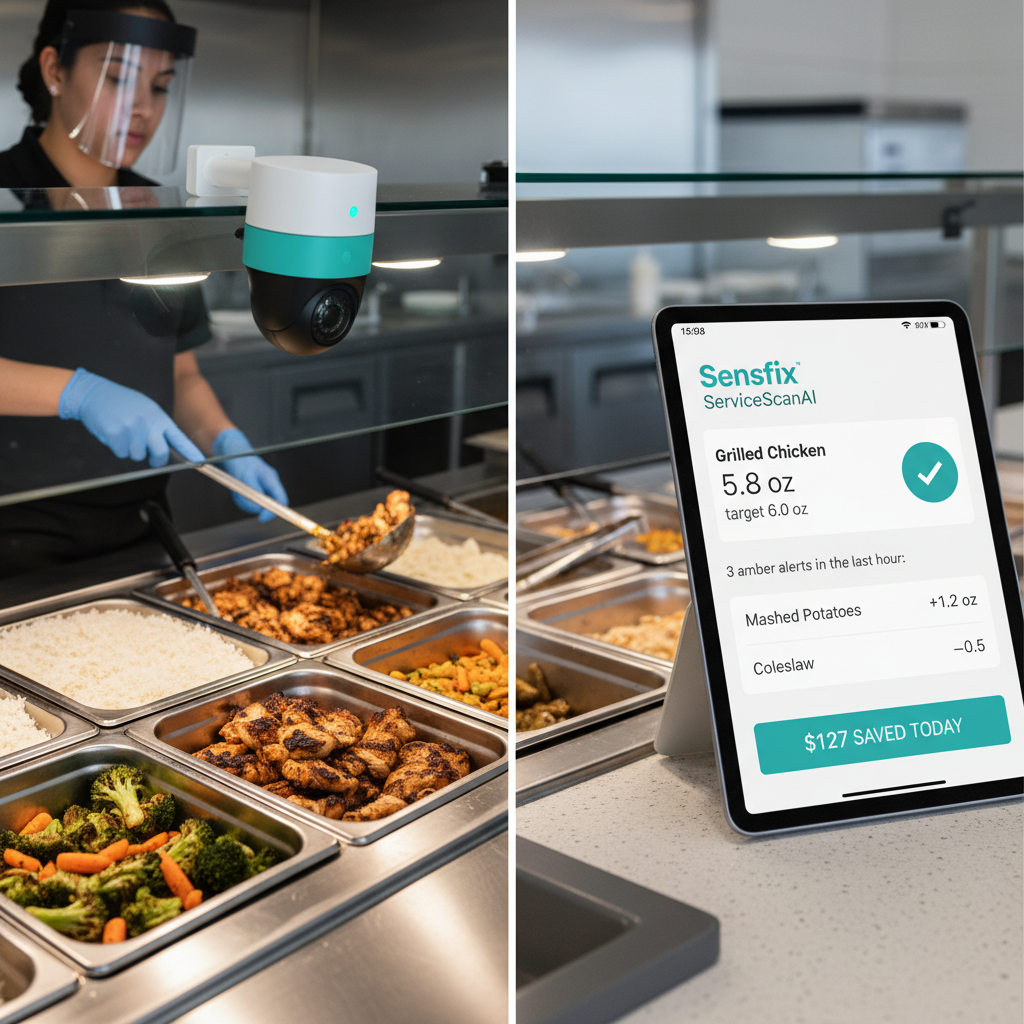
ServiceScanAI can be trained on menu-specific items to monitor portion sizes from overhead cameras. The Multimodal Rule Engine flags deviations from standard portions in real time, triggering alerts to kitchen staff before the plate leaves the window.
The critical difference: the same computer vision platform that monitors portion control also tracks food waste, verifies order accuracy, and monitors kitchen hygiene, all from existing cameras. One investment serves the entire back-of-house operation. Cross-reference: proven visual classification across European retail chains and industrial inspection at the world’s second-largest train manufacturer.
Order Accuracy & Quality Assurance
The Problem
Wrong orders cost QSRs approximately 6% of revenue in wasted food and refunds. For delivery platforms, a wrong order cannot be corrected after dispatch; the entire meal is refunded or replaced. With delivery now exceeding 50% of orders at some locations, the cost of inaccuracy has escalated dramatically.
Real-World Performance Data
| Deployment | Scope | Result |
|---|---|---|
| Plainsight AI | Custom-built vision models at major restaurant chains | Order quality and accuracy assurance in production |
| Agot AI | Real-time kitchen monitoring | Instant alerts when incorrect ingredients detected |
| VisionX | QSR order verification | Reports wrong orders cost ~6% of QSR revenue |
How Sensfix Catches Errors Before They Leave
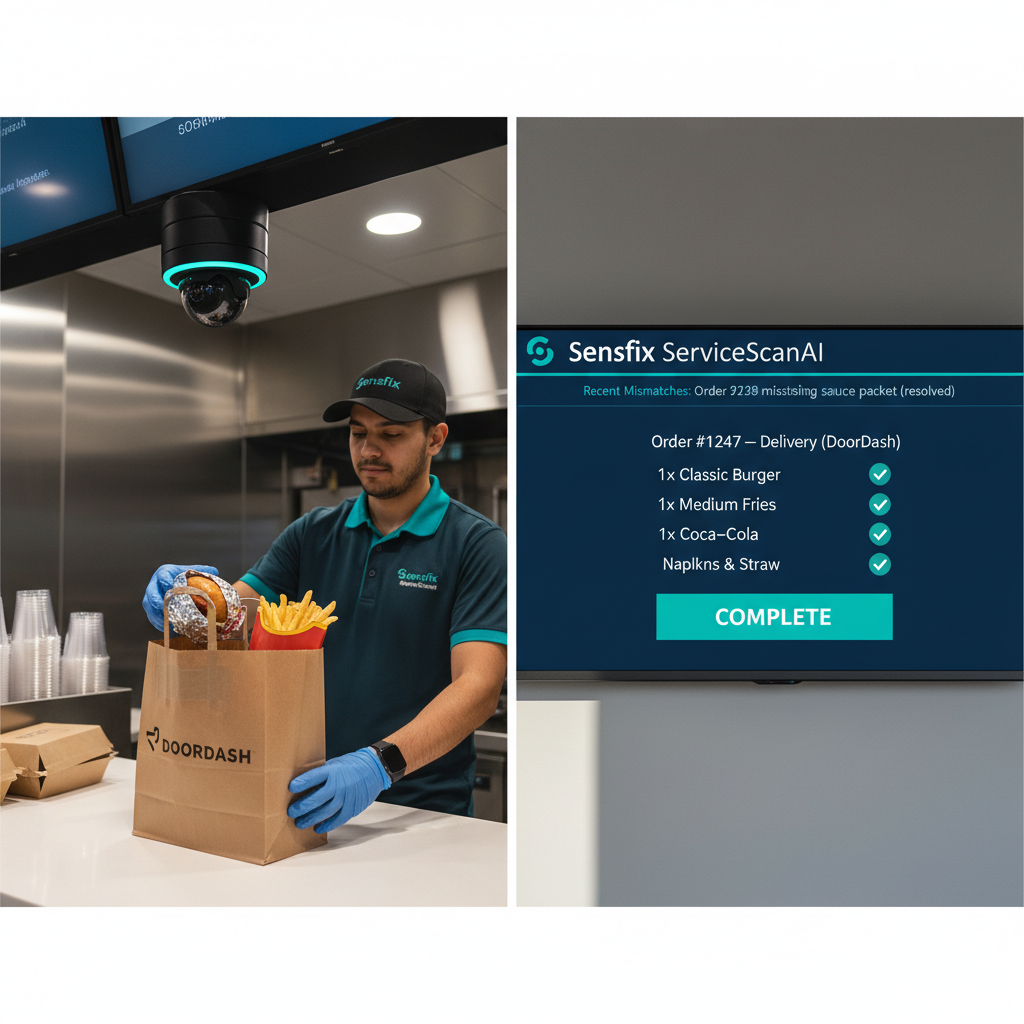
ServiceScanAI integrates with POS systems to compare prepared items against digital orders using instance segmentation. The Multimodal Rule Engine flags missing items, wrong items, and packaging errors before bags are sealed.
42+ proprietary defect-detection models, proven across industrial quality assurance at the world’s second-largest train manufacturer and commercial building portfolios, adapt to food item classification. The same pipeline that detects surface defects on steel detects missing toppings on a burger.
Food Safety & Hygiene Compliance Monitoring
The Problem
Health inspections occur only a few times per year, creating gaps where violations go undetected. Paper-based compliance logs are filled out retroactively. The CDC estimates 48 million Americans get sick from foodborne illness annually. A single food safety violation can trigger fines, closures, or catastrophic brand damage. The AI in food safety market is projected to grow from $2.7B (2024) to $13.7B by 2029.
Named Deployments with Results
| Deployment | Scope | Result |
|---|---|---|
| Plainsight AI | Major US fast-food chain | 95% accuracy in hygiene monitoring via vision |
| FAMA Technologies | Global fast-food chains | Real-time food handling and PPE compliance alerts |
| Outback Steakhouse (Portland pilot) | AI-driven cameras in real time | Staff activity and hygiene compliance tracking |
How Sensfix Monitors Continuously from Existing Cameras
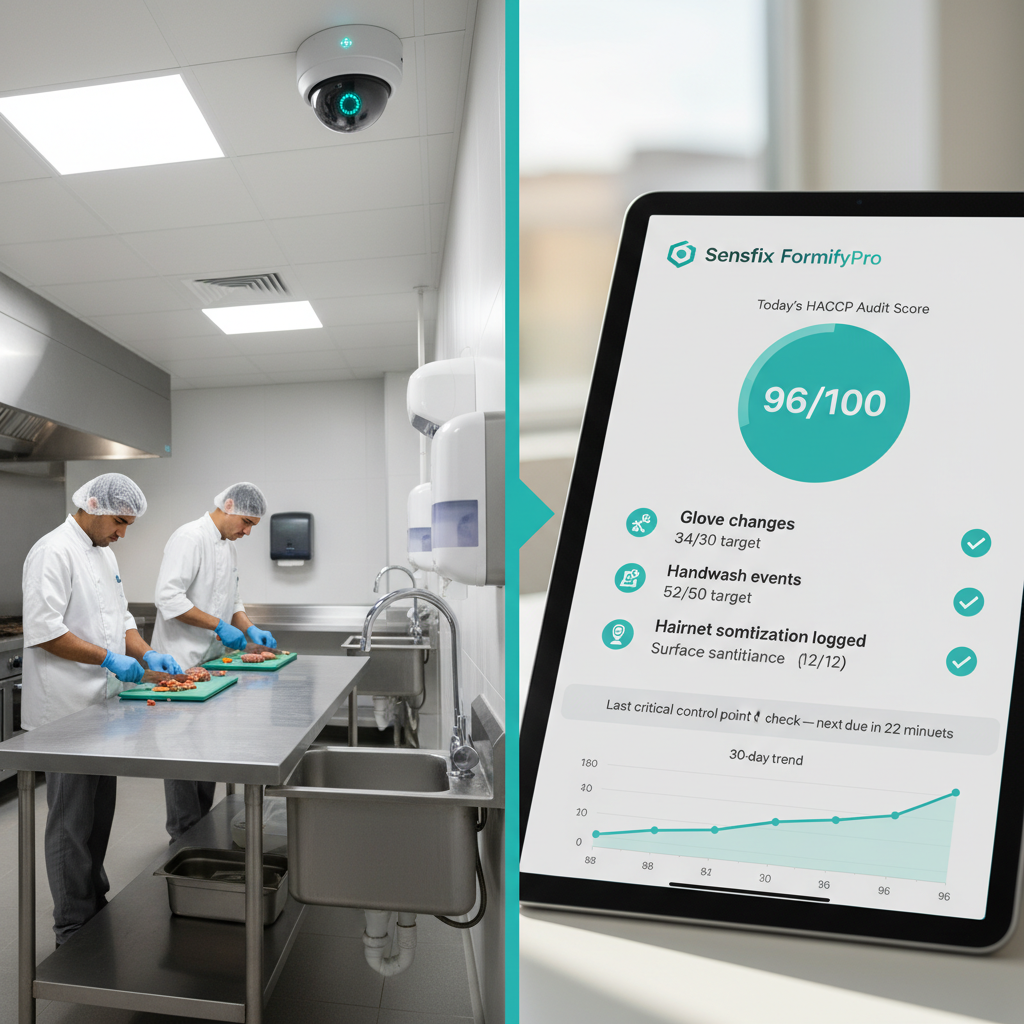
ServiceScanAI + ReportAI + FormifyPro + Multimodal Rule Engine provides 24/7 continuous monitoring on existing CCTV. AI classifies violations in real time, sends instant alerts to managers, and generates timestamped photo evidence for compliance records.
TaskflowDigitizerAI triggers corrective action workflows when violations are detected. The same PPE detection capability proven at Port of Tampa for safety compliance (hard hats, vests, safety glasses) adapts directly to kitchen compliance: hairnets, gloves, chef coats, handwashing frequency.
No dedicated hand-scanning hardware required. No new cameras. Sensfix works with whatever CCTV is already installed for fire safety or security purposes.
Temperature & Cold Chain Monitoring
The Problem
Staff manually check refrigerator temperatures multiple times daily using paper logs. Temperature excursions during off-hours go undetected until the next shift arrives. By that time, thousands of dollars of food could be spoiled. A single walk-in cooler failure at a restaurant causes $10,000–$50,000+ in food loss.
What Leading Operators Report
| Deployment | Scope | Result |
|---|---|---|
| Swift Sensors | Franchise cold chain monitoring | Prevented $50,000 food loss when freezer compressor started failing at 11 PM on a Saturday; alert came instantly, repair completed by morning service |
| McDonald's 12-store franchise | IoT temperature monitoring | Cost savings reported within first two months |
| Open Kitchen (Powerhouse Dynamics) | Multi-unit restaurant brands | Enterprise refrigeration monitoring across all locations |
How Sensfix Adds Intelligence Beyond Temperature Alerts
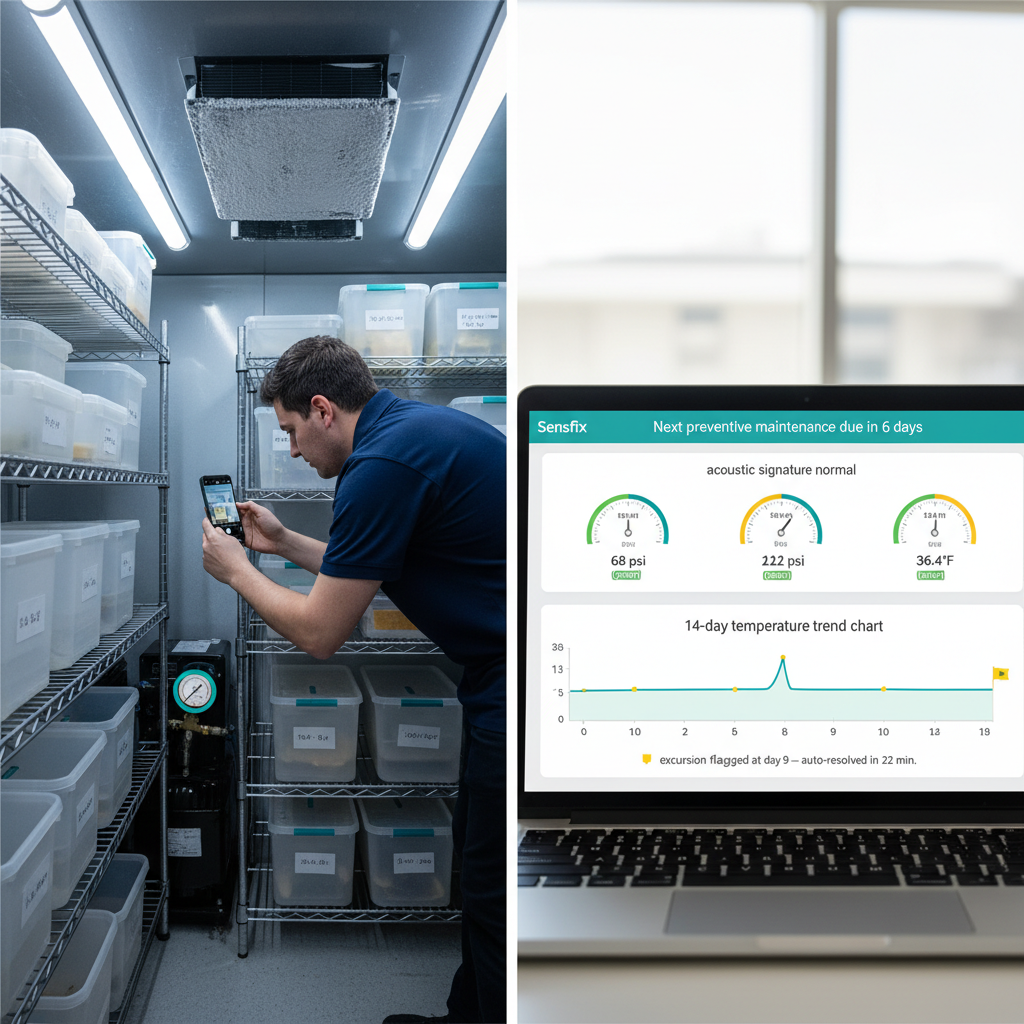
ServiceOCRPro reads analog gauges and digital displays via OCR during inspection rounds, proven at Cadagua wastewater facility for industrial gauge digitization. Audio AI Rule Engine detects compressor degradation from acoustic signatures weeks before failure.
The Multimodal Rule Engine triggers alerts when temperatures drift outside safe ranges. The critical difference: Sensfix doesn’t just monitor temperature. It monitors the equipment that maintains temperature. When a compressor sound changes, you know about the problem before the food spoils, not after.
AI-Powered Food Waste Tracking & Reduction
The Problem
Between 5–15% of food purchased by commercial kitchens is typically wasted. $162 billion in food is lost annually in US restaurants. The UN reports that 26% of total food waste occurs in food service establishments. Manual waste tracking is inconsistent, time-consuming, and often abandoned during busy service periods.
What Industry Leaders Achieve
| Deployment | Scope | Result |
|---|---|---|
| Winnow Vision × IKEA | 23 UK & Ireland stores | $37M+ saved; kitchens using Winnow typically cut waste in half |
| Winnow Vision × Marriott UK/Ireland/Nordic | Chain-wide AI waste monitoring | 25% waste reduction in 6 months across 3,000+ team members |
| Winnow Vision × Hilton Dubai Jumeirah | Single property pilot | $65,000 saved |
| Leanpath × UCSF | Hospital food service | $60,000 savings, 35% waste reduction |
How Sensfix Delivers This as Part of a Complete Platform
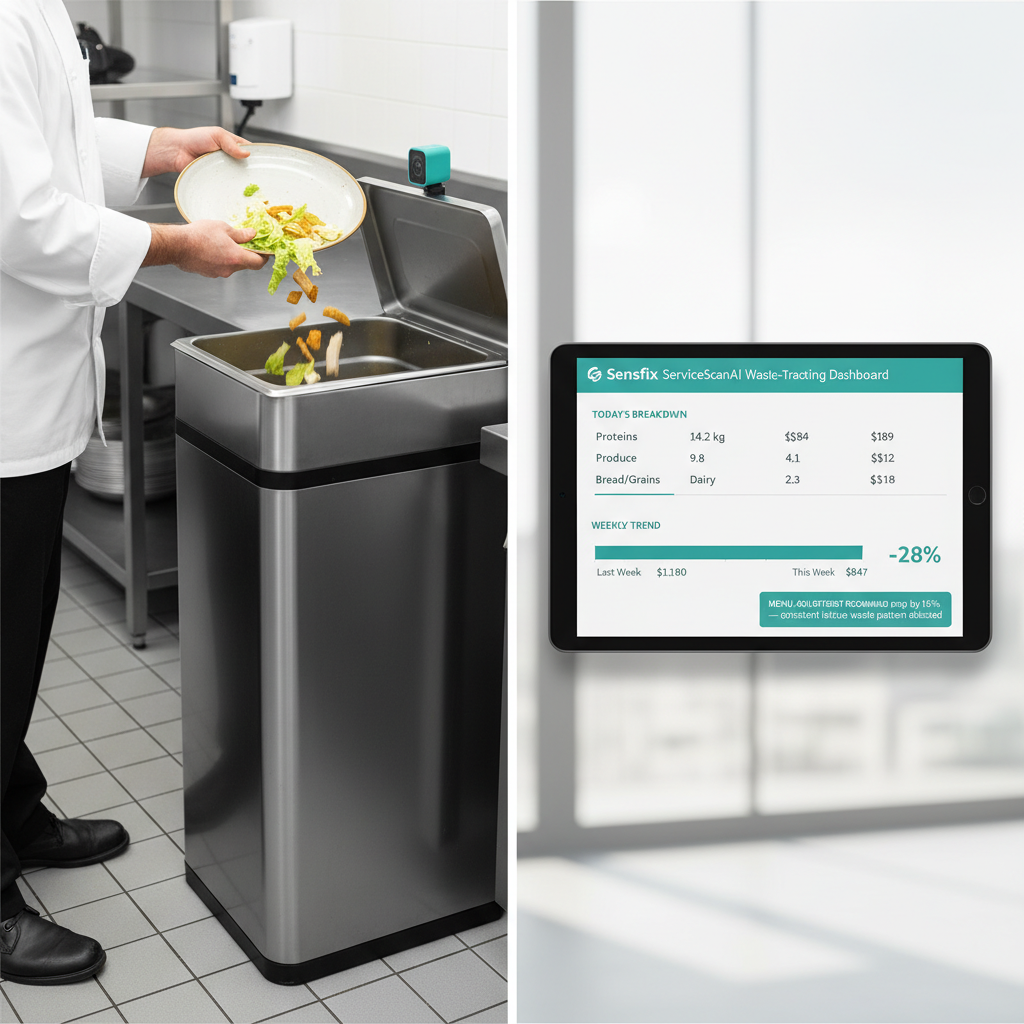
ServiceScanAI + FormifyPro + Multimodal Rule Engine monitors waste disposal events via overhead cameras. AI classifies discarded items, calculates cost impact, and generates daily/weekly waste reports with trend analysis. The rule engine triggers menu adjustment recommendations when waste thresholds are exceeded.
The critical differentiator: Winnow is a dedicated food waste platform. Sensfix delivers food waste tracking alongside kitchen hygiene monitoring, equipment maintenance, order accuracy verification, and facility operations, all from the same suite. Typical ROI for waste tracking: 200–1,000% within year one.
Drive-Through Queue Management & Optimization
The Problem
Drive-through performance is measured by basic timer systems with no real-time visibility into queue lengths or dwell times at each station. Drive-throughs account for 50–70% of QSR revenue. Staffing decisions are based on historical averages, not actual current demand, leading to long waits during unexpected surges.
How Leading QSRs Are Moving
| Deployment | Scope | Result |
|---|---|---|
| Yum! Brands (Taco Bell, KFC, Pizza Hut) | NVIDIA computer vision for drive-through traffic | Expanding to 500 restaurants |
| Wendy's FreshAI (Google Cloud) | AI-powered drive-through optimization | Service times 22 seconds faster at Columbus test site |
| Taco Bell 'Defy' concept | Digital-first drive-through design | Targets two-minute handoffs for digital orders |
Proven Vehicle Tracking Applied to Drive-Throughs
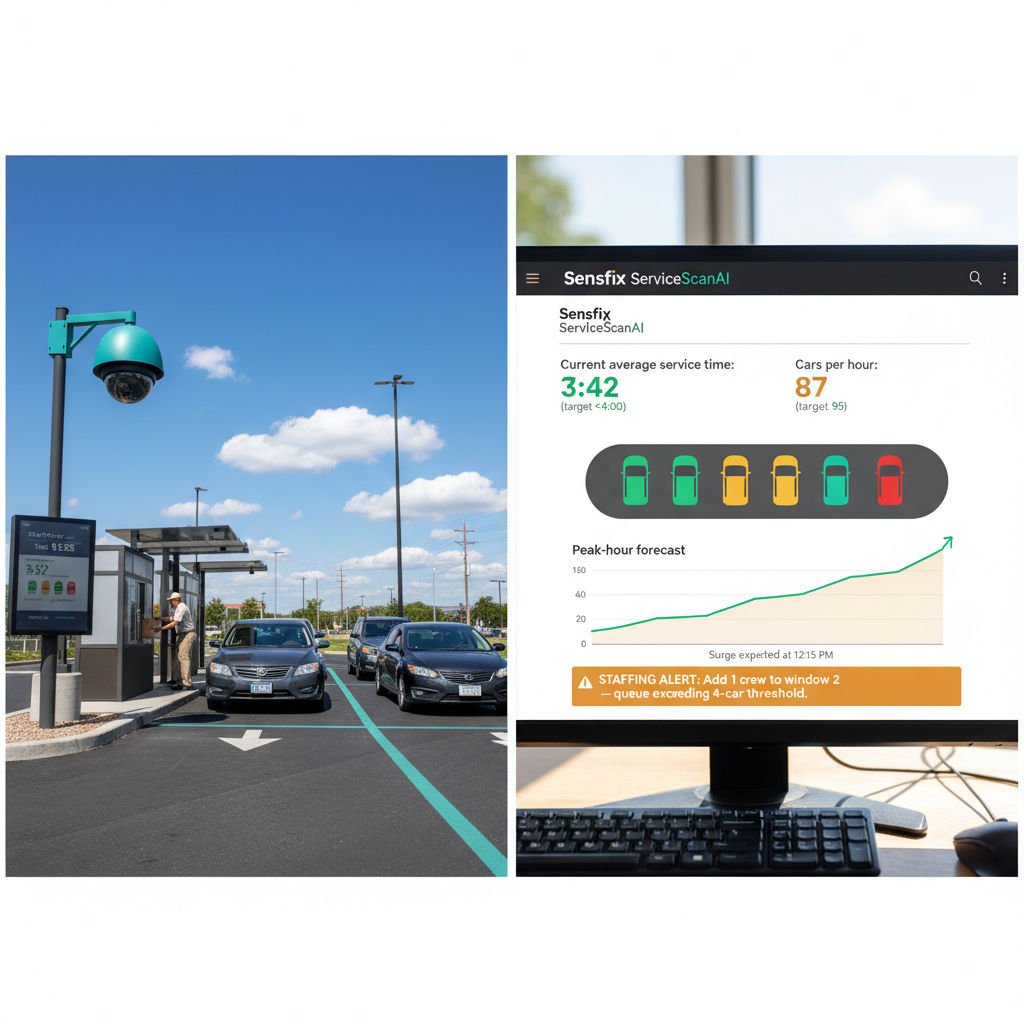
ServiceScanAI + Multimodal Rule Engine analyzes live drive-through feeds for vehicle detection, counting, and queue tracking. Real-time dashboards show average wait times, cars per hour, and peak patterns. The rule engine triggers staffing alerts when queue thresholds are exceeded.
The same vehicle detection and counting technology proven at Port of Tampa for container truck tracking with <1% error rate applies directly to drive-through lanes. One platform delivers queue analytics alongside kitchen monitoring, food safety, and facility maintenance.
Kitchen Equipment Predictive Maintenance
The Problem
Restaurants rely on reactive maintenance or calendar-based schedules. Emergency repair costs are 3–9x higher than preventive maintenance. A single unplanned HVAC failure during a Florida summer dinner service is catastrophic. Walk-in cooler failure causes $10,000–$50,000+ in food loss. QSR equipment downtime directly impacts the $900B+ US restaurant industry.
What Leading Operators Report
| Deployment | Scope | Result |
|---|---|---|
| Envigilance | Franchise equipment monitoring | Prevented $50,000 food loss: failing freezer compressor detected at 11 PM Saturday, repair completed by morning |
| McKinsey benchmark | Cross-industry predictive maintenance | 30–50% reduction in unplanned downtime; 10–40% maintenance cost reduction |
| Open Kitchen (Powerhouse Dynamics) | Multi-unit restaurant brands | Typical savings: $1,740/month for a 4,200 sq ft restaurant |
How Sensfix Predicts Failures Before They Happen
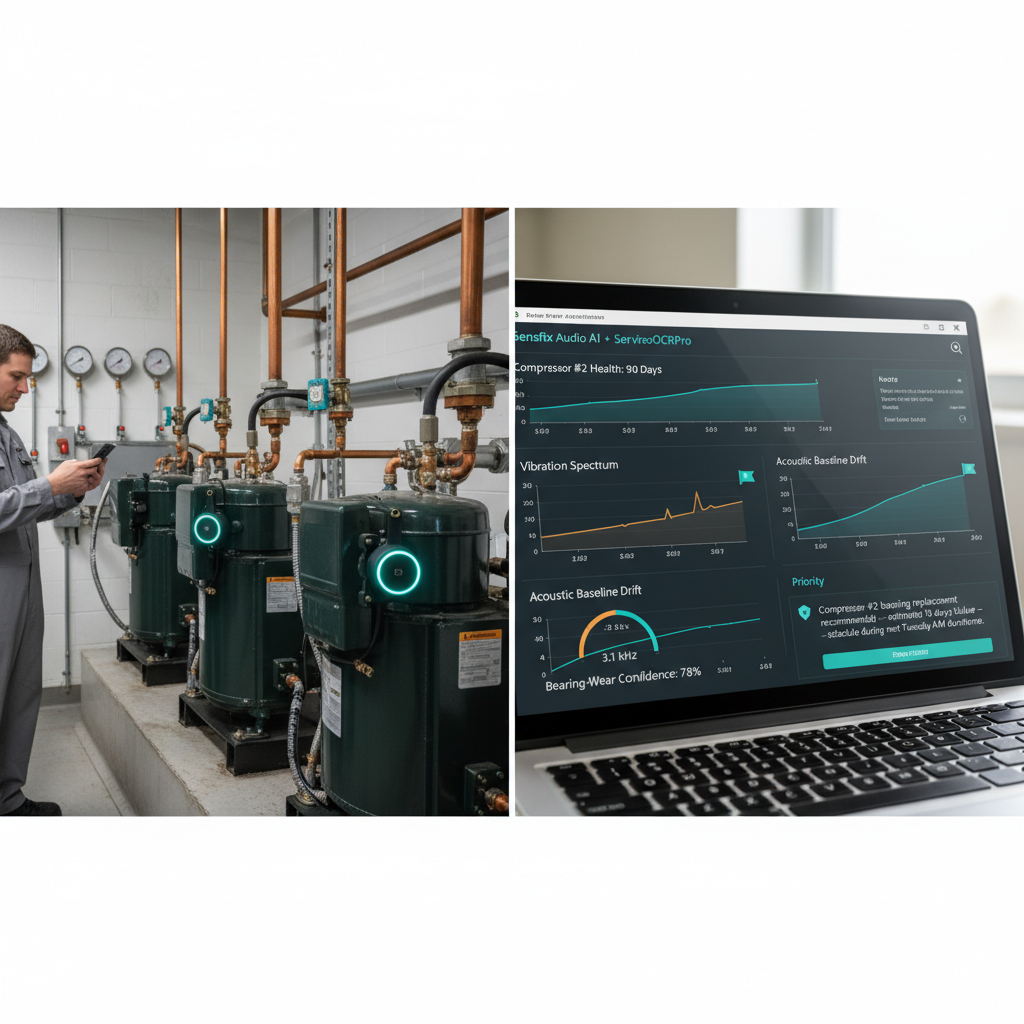
Audio AI Rule Engine captures acoustic baselines for every piece of rotating kitchen equipment (compressors, motors, fans, pumps) and detects degradation from sound changes alone. The same technology proven at the world’s second-largest train manufacturer for compressor air leakage detection.
ServiceOCRPro reads equipment panel displays automatically during rounds. TaskflowDigitizerAI triggers digitized maintenance SOPs with photo verification at every step. The complete cycle: detect anomaly → create ticket → dispatch technician → execute workflow → verify completion, all automated.
Automated Gauge & Meter Reading
The Problem
Maintenance staff manually read temperature gauges, pressure meters, and equipment displays during daily rounds, writing values on paper forms. This process is time-consuming, error-prone, and creates data rarely analyzed until something goes wrong. Readings taken once or twice daily miss fluctuations between checks.
A First-Mover Opportunity
No published peer deployment of smartphone-based OCR gauge reading specifically for restaurants. The underlying technology is proven across industrial facilities globally. Sensfix has the opportunity to establish the first restaurant-specific reference case.
A Proven Sensfix Capability
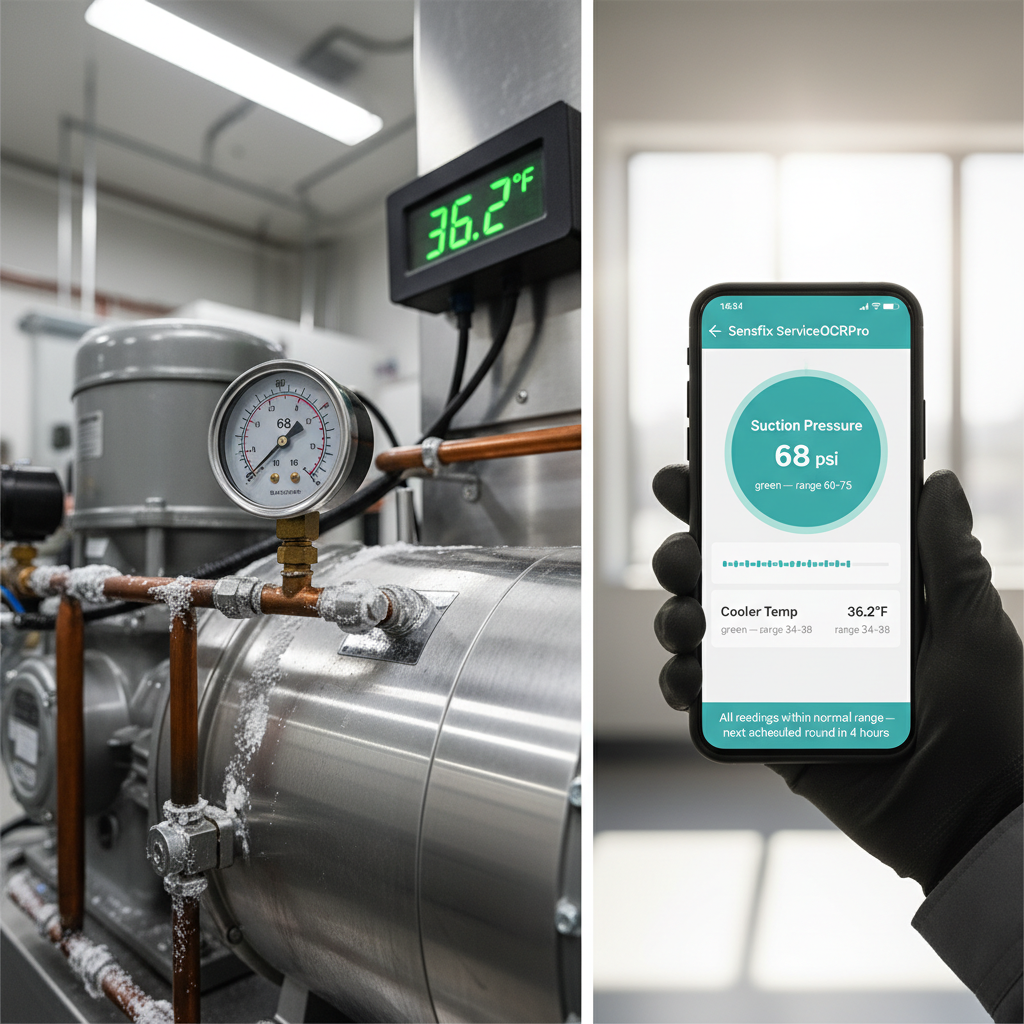
This is a PROVEN Sensfix capability. ServiceOCRPro is one of five products in the SAAI Suite, specifically designed for automated gauge and meter reading with rules-based alerting. Service technicians point their phone camera at any gauge, analog or digital, and AI reads values instantly, flags readings outside normal ranges, and logs everything automatically.
Deployed at wastewater utilities (Cadagua) and railway manufacturers (the world’s second-largest train manufacturer) across 3 continents. The same OCR technology that reads industrial pressure gauges reads kitchen refrigeration thermometers. One platform, one capability, applied to a new vertical.
Worker Safety: Slip, Trip & Fall Prevention
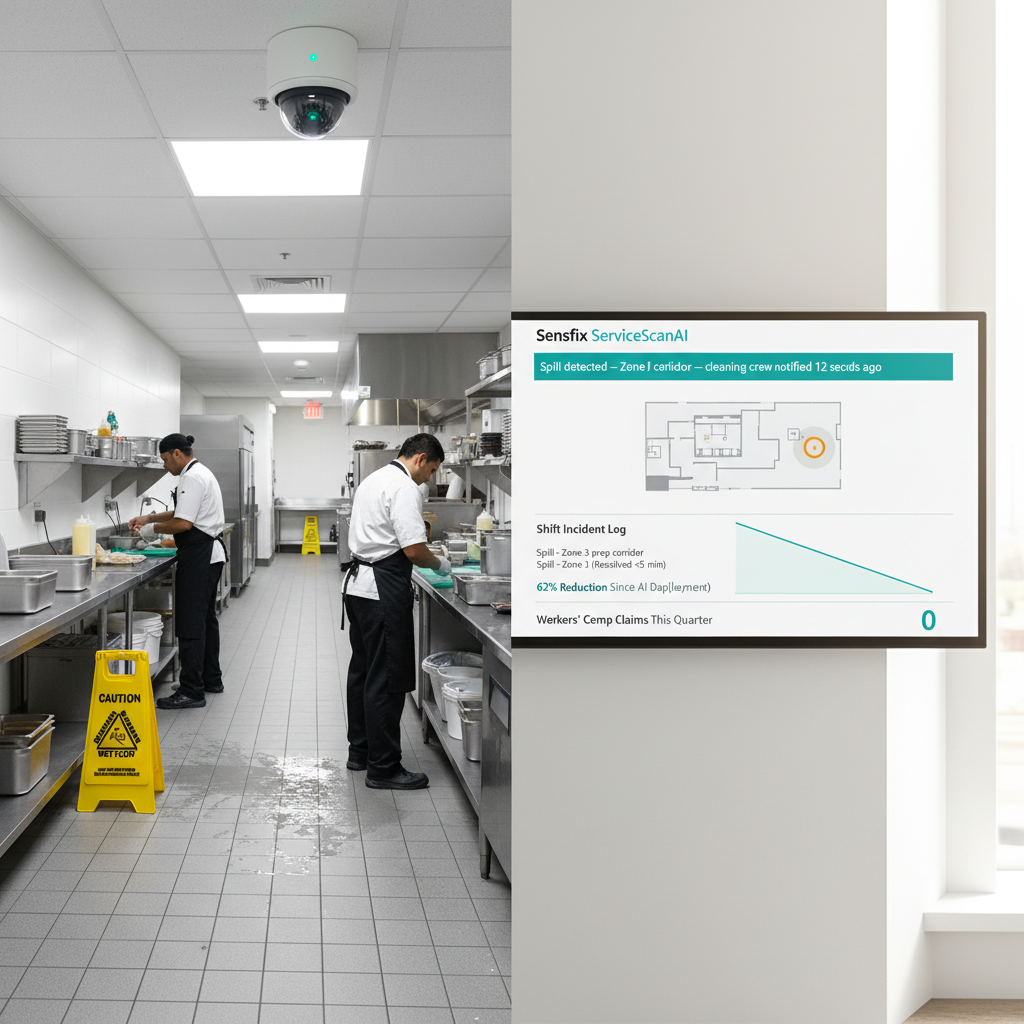
The Problem
Slip-and-fall incidents are among the leading causes of workers' compensation claims in restaurants. Nearly 80% of fast-food employees sustained burns within the past year (Hart Research 2024). Restaurant workers are 6.5x more likely to get burned than the average US worker. Falls account for approximately 8 million ER visits annually in the US.
What Safety Platforms Deliver
| Deployment | Scope | Result |
|---|---|---|
| Visionify | Dedicated slip-and-fall prevention modules | Monitors hundreds of high-risk zones simultaneously; real-time dashboards and instant mobile/email alerts |
| Disrupt Labs / ImageVision.ai | AI safety monitoring for commercial environments | Real-time hazard detection from existing camera infrastructure |
Proven Safety Analytics Applied to Restaurants
ServiceScanAI + Multimodal Rule Engine + TaskflowDigitizerAI detects spills, wet floors, and obstacles in real time on existing CCTV. Fall detection triggers immediate supervisor notification with timestamped footage.
All incidents are logged with timestamped evidence for insurance and workers’ compensation documentation. The same safety monitoring proven at commercial building portfolios and Ferrovial industrial facilities. Dedicated safety platforms solve one problem; Sensfix delivers safety monitoring alongside kitchen operations, equipment maintenance, and facility management from a single platform.
Table Occupancy & Customer Flow Management
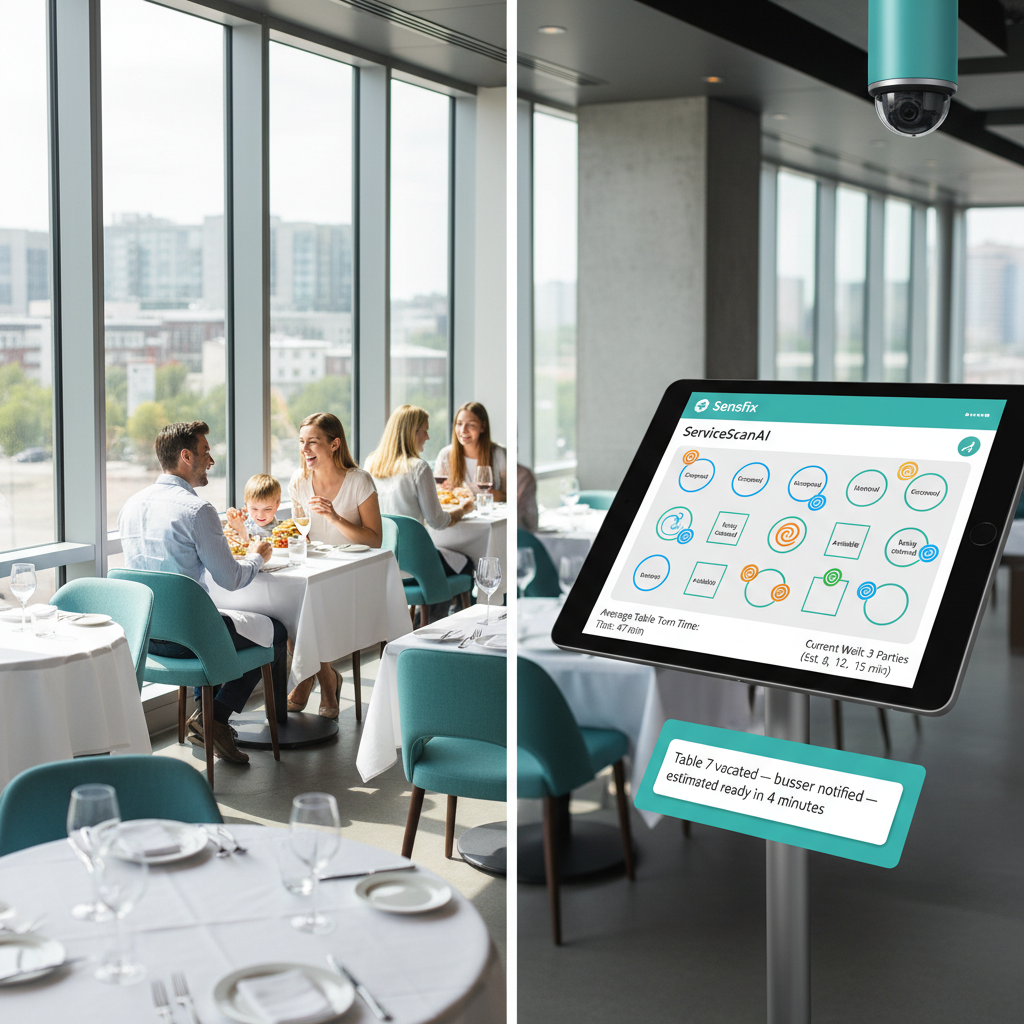
The Problem
Host staff visually track table availability from a podium, often walking the dining room to check status. In large restaurants, this leads to missed open tables, unnecessary wait times, and customer walkouts. Excessive wait times drive abandonment rates as high as 30% in busy settings. There is no data on actual table utilization rates or peak-period bottlenecks.
Where This Is Being Piloted
| Deployment | Scope | Result |
|---|---|---|
| Outback Steakhouse (Portland pilot) | AI cameras tracking guest movement and table status | Managers quickly identify open/uncleared tables, adjust staffing, speed up seating |
| FAMA Technologies | Restaurant occupancy AI | Guest movement visualization and layout optimization |
How Sensfix Delivers Real-Time Table Intelligence
ServiceScanAI + Multimodal Rule Engine analyzes CCTV feed to capture table/seat availability in real time. Restaurant managers access a map view displaying availability status of all tables. Alerts are sent when tables are vacated and ready for turnover.
The same occupancy monitoring deployed across commercial building portfolios with real-time space utilization dashboards. One platform delivers table management alongside kitchen monitoring, safety, and facility operations.
Customer Traffic Analysis & Personalized Experience
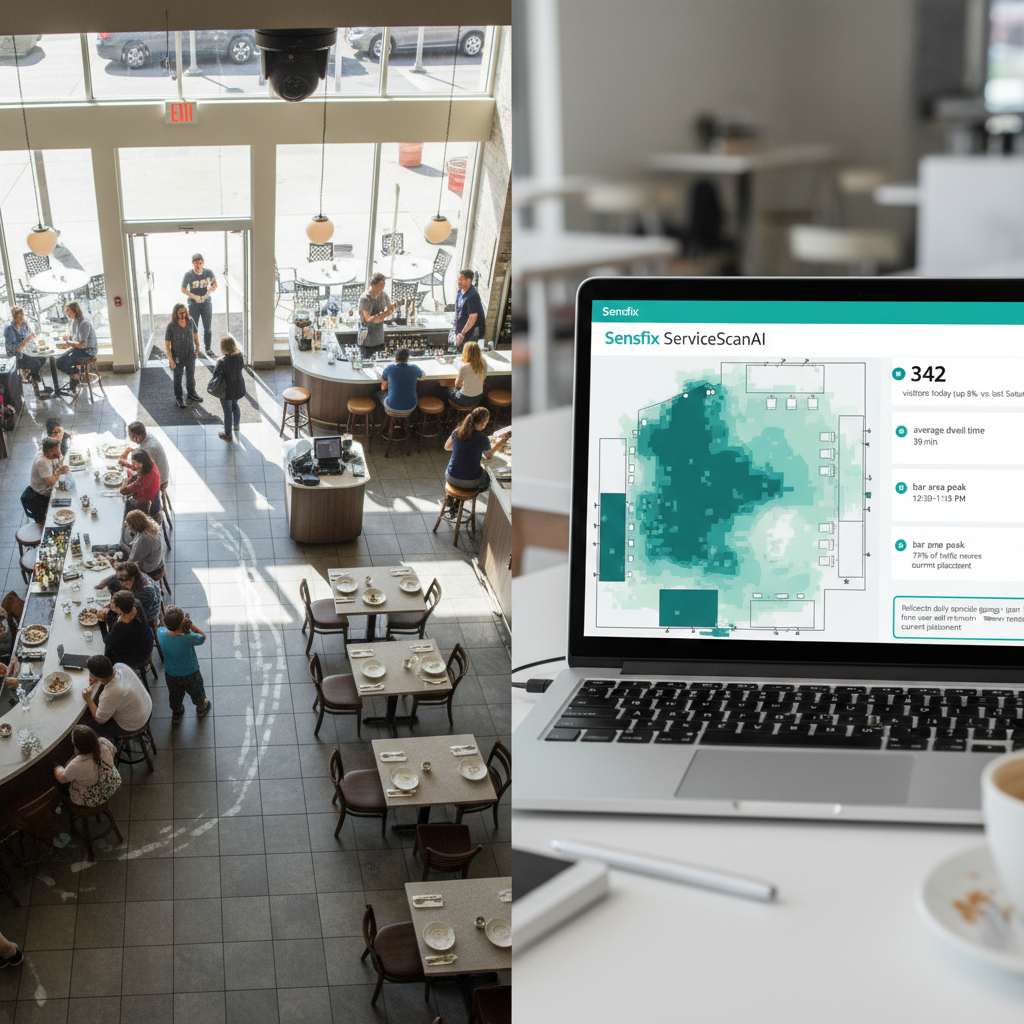
The Problem
Customer behavior data is limited to POS transaction records. There is no way to measure how customers move through the space, where they linger, or what catches their attention. 73% of restaurant executives plan to increase AI investment (Deloitte 2025), yet most lack the data infrastructure to make customer-experience decisions.
How Industry Innovators Approach This
| Deployment | Scope | Result |
|---|---|---|
| Nova (founded by former Tesla engineers) | Terabytes of visual data processing | Predictive dashboards; operators optimize layouts and preempt bottlenecks |
| VisionX / FAMA Technologies | Customer traffic analytics | Scalable from single stores to enterprise chains |
How Sensfix Turns Cameras into Customer Intelligence
ServiceScanAI + Multimodal Rule Engine uses existing CCTV for anonymized footfall analysis, heatmap generation, and dwell-time tracking. AI correlates traffic patterns with staffing levels for optimal resource allocation.
The same occupancy and flow analytics deployed at commercial buildings and ports (Port of Tampa) for people and vehicle movement intelligence. The difference: dedicated traffic analytics platforms deliver one view. Sensfix delivers customer intelligence alongside operations, safety, and facility management.
Staff Productivity & Zone-Based Workforce Optimization
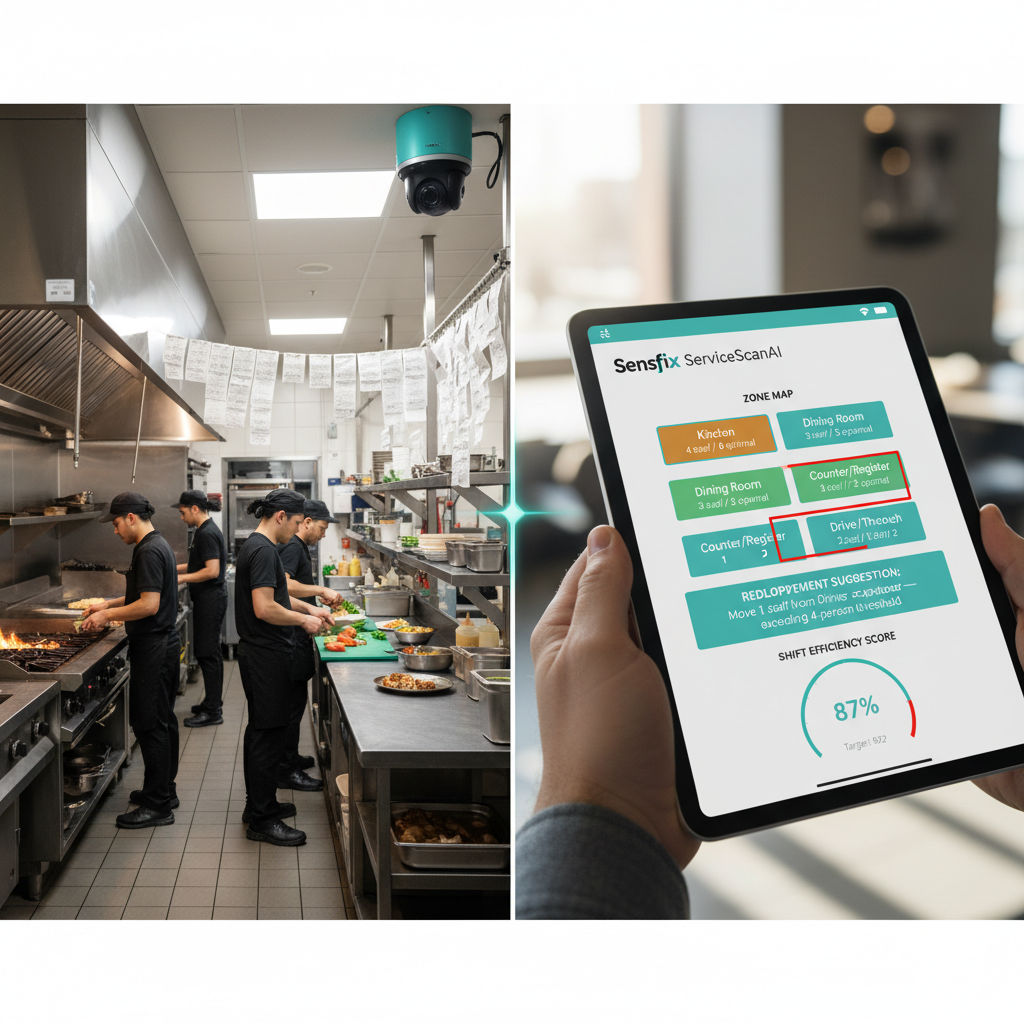
The Problem
Staffing is based on historical averages and manager intuition. There is no real-time visibility into whether staff are deployed optimally across front-of-house and back-of-house during shifting demand patterns. QSR labor turnover at 144% annually makes efficient workforce deployment critical for the $900B+ US restaurant industry.
What the Industry Is Deploying
| Deployment | Scope | Result |
|---|---|---|
| FAMA Technologies | Restaurant AI vision suite | Staff presence monitoring, productivity tracking, customer interaction quality analysis |
| Roboflow / QSR technology providers | Zone-based occupancy analytics | Real-time workforce optimization |
How Sensfix Optimizes Staffing in Real Time
ServiceScanAI + Multimodal Rule Engine counts people in specific restaurant zones using existing CCTV. AI correlates staffing levels with service speed metrics to identify optimal staff-to-customer ratios by zone and time period.
The same zone-based analytics deployed across commercial building portfolios and port facilities. One platform delivers workforce optimization alongside kitchen monitoring, safety, and facility management.
Liquor Bottle Inventory via Computer Vision
The Problem
Bar inventory is one of the most labor-intensive and error-prone tasks in restaurant operations. Manual pour counting, weigh-and-measure systems, and periodic physical counts are slow, inconsistent, and easily manipulated. Shrinkage from over-pouring, theft, and unrecorded consumption costs bars 20–25% of revenue. Most bars have zero visibility into bottle-level consumption between full inventory counts.
Why Existing Solutions Fall Short
| Solution | Approach | Limitation |
|---|---|---|
| Bartrack | Hardware-based pour monitoring | Requires sensors on every bottle at $50–$200 per monitored position |
| Partender | Specialized scales and measurement tools | Expensive hardware per position; manual setup |
| Sensfix ServiceScanAI | Smartphone camera scan | Zero hardware; same result from a phone |
A Proven Sensfix Capability: Already in Production
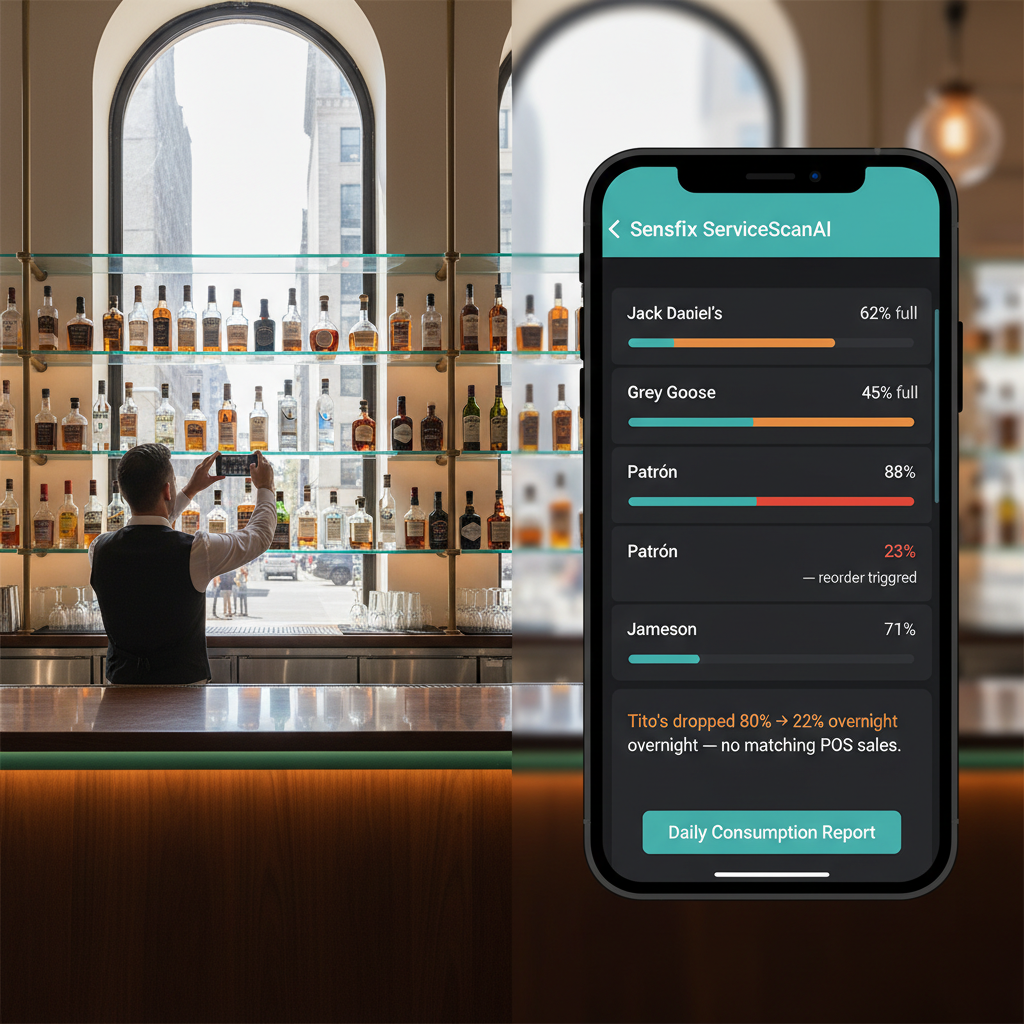
This is a PROVEN Sensfix capability already deployed in production. ServiceScanAI’s computer vision identifies liquor bottle brands from shelf photos and estimates fill levels (percentage of liquid remaining) from the visual profile. Bar staff or the owner simply scans shelves using the Sensfix mobile app.
The Multimodal Rule Engine compares current levels against previous scans to calculate consumption, flag anomalies (e.g., a bottle that dropped from 80% to 20% overnight without corresponding sales), and generate automated inventory reports. The owner gets 100% visibility into liquor usage patterns across every scan interval: daily, shift-by-shift, or on-demand.
Where competitors require $50–$200 per monitored position in dedicated hardware, Sensfix achieves the same result with a smartphone camera. Zero hardware investment. Zero installation. Immediate deployment.
Maintenance & Issue Management
The Problem
A maintenance issue (leaking pipe, broken fryer, flickering light) requires a phone call or email to a facility manager who classifies, finds a technician, checks skills/location, and dispatches. JLL benchmarks show this process averages 21 minutes per issue. During peak dinner service, these delays compound into significant operational disruptions.
A First-Mover Opportunity for Restaurants
No published peer deployment of AI-powered, smartphone-scan-based issue classification and automated ticket routing specifically for restaurants. The technology is proven across other industries. Sensfix has the opportunity to establish the first restaurant-specific reference.
A Proven Sensfix Capability: From 21 Minutes to Seconds
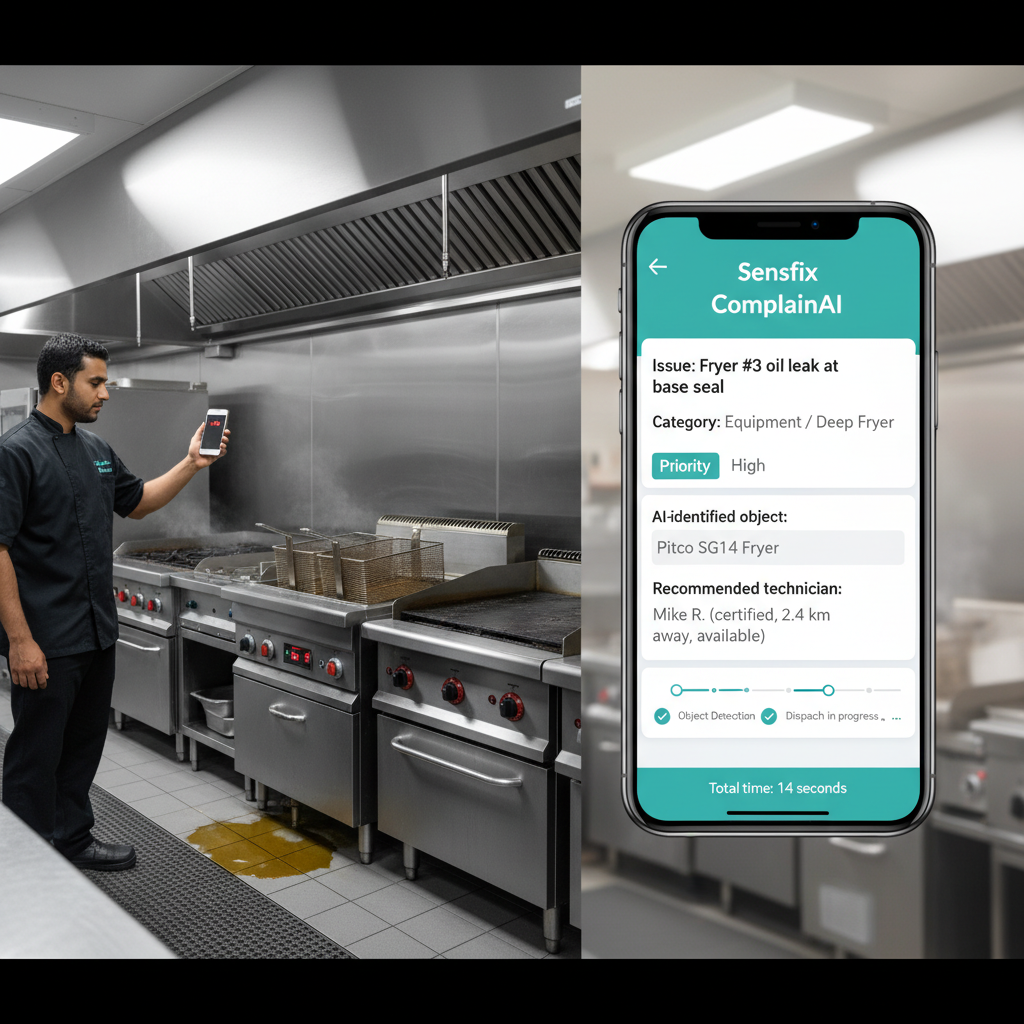
This is a PROVEN Sensfix capability. ReportAI + TaskflowDigitizerAI + FormifyPro + ServiceScanAI provides end-to-end issue management. Six AI agents work autonomously: object detection, issue classification, ticket creation, technician dispatch, workflow execution, and completion verification.
Deployed at Ferrovial, the world’s second-largest train manufacturer, and commercial buildings across 3 continents, consistently transforming the 21-minute industry benchmark to seconds. Staff scan any issue with their phone; AI handles everything from classification to dispatch to resolution tracking.
Facility Management: Multi-Location Global View
The Problem
Multi-unit restaurant brands have no centralized visibility across locations. Equipment health, maintenance status, compliance records, and operational metrics are siloed per location. 73% of restaurant executives plan to increase AI investment (Deloitte 2025), with inventory management and operational intelligence among the highest-adoption use cases.
What Multi-Unit Platforms Deliver
| Deployment | Scope | Result |
|---|---|---|
| Open Kitchen (Powerhouse Dynamics) | Enterprise IoT for multi-unit restaurant brands | Food preparation, refrigeration, and HVAC monitoring across all locations |
| Steakhouse owner case study | Equipment anomaly detection | Char-broiler pulling 20% more power detected; $150 cleaning prevented a $3,000 repair |
Enterprise-Wide Visibility from a Single Platform
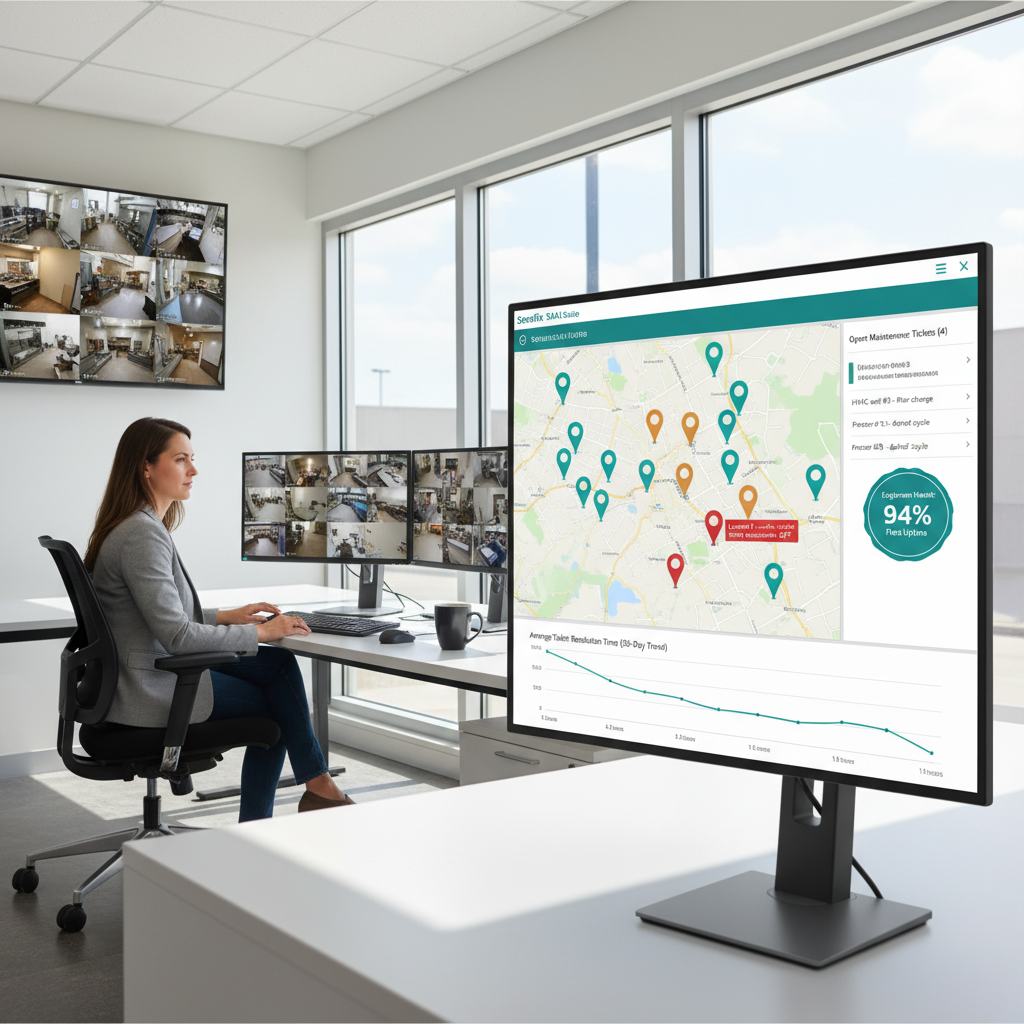
Full SAAI Suite (ServiceScanAI + FormifyPro + ReportAI + TaskflowDigitizerAI + ServiceOCRPro + Multimodal Rule Engine) provides enterprise-wide facility management. Map view / list view displays all facilities with real-time status indicators. AI automates escalation when issues exceed thresholds.
Proven across 46 enterprise clients on 3 continents with centralized multi-site facility management. The same dashboard that monitors a European retail chain with 4,600+ stores monitors a 50-location restaurant brand. One platform, one contract, one training investment.
Geofencing & Access Control for Restricted Areas
The Problem
Restricted areas in restaurants (liquor storage, cash rooms, inventory rooms) rely on physical keys or basic pin-code locks that are easily shared or compromised. Shrinkage from unauthorized access costs bars 20–25% of revenue. There is no audit trail of who accessed what area and when, making theft investigation nearly impossible.
A First-Mover Opportunity
No published peer deployment of AI-powered facial recognition access control specifically for restaurant restricted areas. The underlying geofencing and zone monitoring technology is proven across industrial and commercial environments.
Proven Zone Monitoring Applied to Restaurant Security
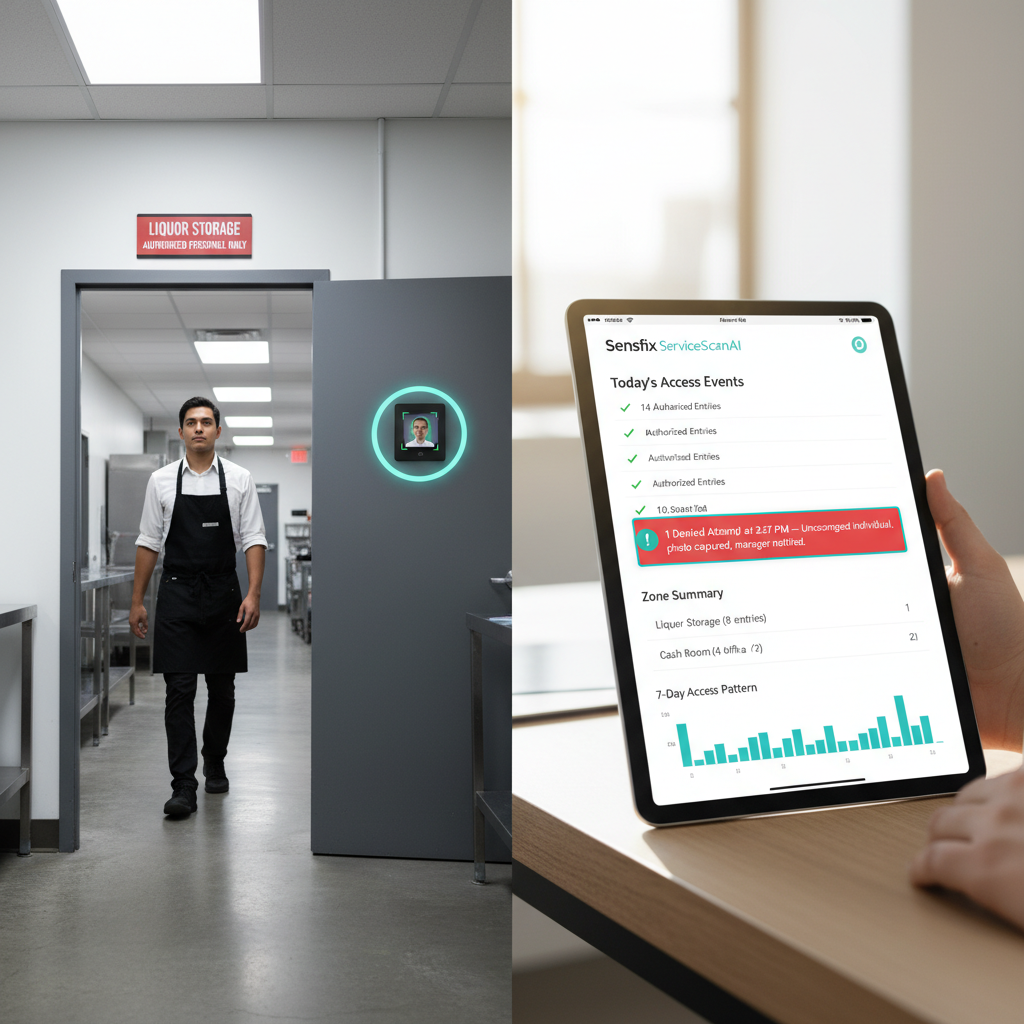
ServiceScanAI + Multimodal Rule Engine uses existing CCTV for recognition-based access control. AI grants or denies access based on recognition results and logs every attempt with timestamped photo evidence. FormifyPro generates access audit reports for management.
The same zone monitoring and geofencing technology proven at 5G manufacturing facilities in Poland for restricted area enforcement and at Port of Tampa for safety zone monitoring. One platform delivers access control alongside kitchen operations, equipment maintenance, and facility management.
Waitlist Management & Smart Seating
The Problem
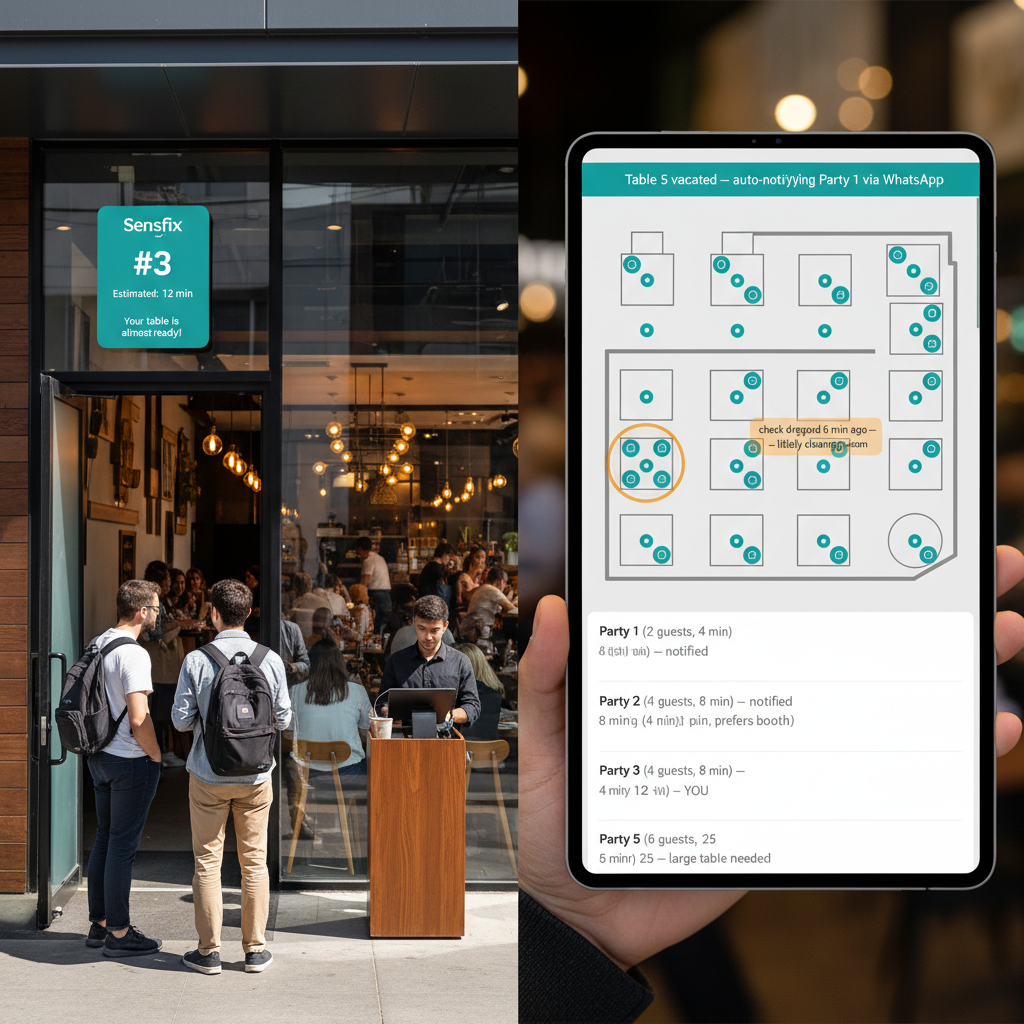
Waitlist management is handled manually by host staff using paper lists or basic buzzer systems. Customers have no visibility into actual wait times or table availability. Excessive wait times drive abandonment rates as high as 30% in busy settings, directly impacting revenue for the $900B+ US restaurant industry.
A First-Mover Opportunity
No published peer deployment of integrated AI-driven waitlist management with real-time computer vision table monitoring. Existing waitlist apps rely on manual host updates rather than automated visual confirmation that a table is actually ready.
AI-Powered Waitlist with Visual Confirmation
Sensfix waitlist management system integrates with ServiceScanAI’s table availability monitoring. Customers log into the mobile app, select their restaurant, and join the waitlist. When a chosen table is freed and reset, the system automatically notifies the waiting customer via app or WhatsApp.
Restaurant managers access map/list views of all tables with real-time status. The same mobile app and real-time notification platform proven across 46 enterprise clients. No buzzer hardware. No manual host updates. Automated visual confirmation that the table is clean, set, and ready.
Transfer Capability Matrix
Every capability listed below is production-proven. The third column shows how each maps to restaurant operations domains documented above.
| Capability | Where Proven | Restaurant Application |
|---|---|---|
| 42+ defect detection models (0.2mm resolution) | Industrial facilities, 3 continents | Food portion control, order accuracy, equipment condition, facility inspection |
| Audio AI for rotating machinery health | World's 2nd-largest train manufacturer (compressors) | Kitchen compressors, HVAC, refrigeration, exhaust fans, fryer pumps |
| Automated gauge/meter OCR (99%+ accuracy) | Cadagua wastewater facility | Temperature gauges, pressure meters, equipment panel displays |
| Safety zone enforcement & PPE detection | US Gulf Coast port (production) | Kitchen PPE compliance, restricted area monitoring, hygiene enforcement |
| Multi-site compliance dashboards | European retail chain (4,600+ stores) | Multi-location restaurant oversight, brand compliance reporting |
| Digital workflows + 80% parts savings | Bay Area automaker | Maintenance SOPs, cleaning checklists, equipment inspection rounds |
| Real-time vehicle tracking (<1% error) | US Gulf Coast port (production) | Drive-through queue counting, parking management |
| People counting & dwell-time analytics | Commercial building portfolios, 3 continents | Customer flow, staff presence, queue detection, table utilization |
| AI-powered issue classification (seconds vs. 21 min) | 46 enterprise clients globally | Maintenance requests, equipment failures, facility issues |
| Baseline comparison (image-to-image) | Bay Area automaker (vehicle body panels) | Liquor bottle fill levels, food portion consistency, equipment condition |
| Process monitoring & coverage verification | Industrial quality control (3 continents) | Food preparation monitoring, hygiene compliance, cleaning QA |
| Geofencing & zone-based access control | 5G manufacturing facility (Poland) | Restricted area access, liquor storage, cash room monitoring |
Implementation Approach
Phase 1: Guided Evaluation (Up to 90 Days)
A structured evaluation where Sensfix deploys the SAAI Suite on two selected use cases under a dedicated services agreement. This phase includes full platform deployment, AI model configuration for restaurant-specific conditions, and comprehensive reporting, ensuring the restaurant operator can evaluate real-world performance with rigor before committing to chain-wide deployment.
Pilot A: Liquor Bottle Inventory & Kitchen Hygiene
Deploy ServiceScanAI for liquor bottle inventory via smartphone scan (proven capability) alongside kitchen hygiene compliance monitoring on existing CCTV. Deliverable: comparative report showing AI findings vs. current manual inventory and hygiene assessment, with shrinkage reduction data.
Pilot B: Equipment Predictive Maintenance & Issue Management
Deploy Audio AI on kitchen equipment for predictive maintenance alongside ReportAI for instant maintenance issue classification and dispatch. Deliverable: equipment health dashboard, maintenance time savings quantification (21 min to seconds benchmark).
Phase 2: Enterprise SaaS Deployment
Following successful evaluation, Sensfix deploys as a chain-wide or multi-location SaaS platform under an annual agreement. Unlimited users, unlimited licenses, unlimited data nodes. Every restaurant manager, kitchen staff member, maintenance technician, and bar manager. Every camera, sensor, and mobile device. No per-user fees, no data caps. One annual platform fee designed so adoption spreads organically without procurement friction.
About Sensfix
Founded
2018 (Delaware C-Corp)
Headquarters
San Francisco, CA
CEO
Balaji Renukumar
Global Offices
San Francisco · Łódź Poland · Seoul South Korea
Enterprise Clients
46 clients across 3 continents
R&D Grant
$2.5M international R&D grant (2022), funding the world's first multimodal rule engine
Research
Stanford University, Department of Computer Science, Robotics Laboratory
Technology Partners
Google Cloud · Microsoft Azure
Key Deployments
World's 2nd-largest train manufacturer · Major European infrastructure group · Port of Tampa / Agunsa · South Korean railways · European retail chain (4,600+ stores) · Bay Area automaker